Today's
EarthStation1.com 15% (Or More!) Off Commemorative Memorial Title:
The Light Stuff: Record Human Powered Flight DVD, Download, USB
Drive
Today, August 23, 2026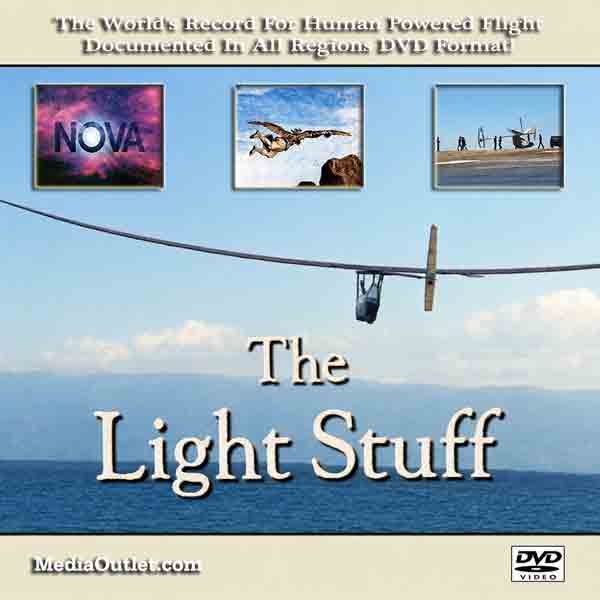
August 23: National Ride The Wind Day: --
The perfect blend of adventure and peace happens today - which is
exactly what taking flight feels like. We have proven time and
time again that we can achieve anything we set our minds to, and
that includes flying too. The creation of human-powered flights
dates back as far as 1923 and successful flights as far back as
1961. The concept has evolved tremendously ever since, and
National Ride The Wind Day commemorates the anniversary of the
first human-powered flight to win the Kremer prize. For a long
time, the only species that could experience the weightless and
peaceful feeling of flying or gliding were aerial animals. That
was until humans started to crave that same feeling. Thus,
introducing us to the concept of flight and Human Powered-Aircraft
(H.P.A.s). These are aircraft belonging to the class of vehicles
known as human-powered vehicles. Early attempts at human-powered
flight were unsuccessful because of the difficulty of achieving
the high power-to-weight ratio. In 1904, the invention of a
bicycle plane was documented, however, attempts made to fly this
plane on July 30 of the same year failed. From that date until
1961, there were several attempts at human-powered flights that
never quite made full flight rounds. Some of these aircraft were,
Gerhardt Cycleplane, Zaschka Human-Power Aircraft, HV-1 Mufli, and
Pedaliante. The first official take-off and landing of a
man-powered aircraft were made on November 9, 1961, by Southampton
University's Man Powered Aircraft (SUMPAC) at Lasham Airfield.
After the Puffin 2 flight on August 27, 1965, less successful
aircraft flew, until 1972 when the Woodford Essex Aircraft Group's
Jupiter flew about 0,8 miles in June. The Royal Aeronautical
Society's 'Man Powered Aircraft Group' was formed in 1959 by the
members of the Man Powered Group of the College of Aeronautics.
Its title was changed from 'Man' to 'Human' in 1988 because of the
many successful flights made by female pilots. Under the auspices
of the Society, in 1973 the industrialist Henry Kremer offered the
Kremer Prize of _50,000 for the first human-powered aircraft to
fly a figure-of-eight course around two markers half a mile apart.
On August 23, 1977, the Gossamer Condor 2 won the prize. National
Ride The Wind Day was set in place to celebrate that. On Sale
Until Midnight Tonight PT!
https://store.earthstation1.com/the-light-stuff-dvd-the-world39s-record-human-powered-flig39.html
Today's
EarthStation1.com 15% (Or More!) Off Commemorative Memorial Title:
Civil Jets: The Boeing 747 Jumbo Jet Documentary DVD, Download,
USB
Today, August 23, 2026
August 23: Cheap Flight Day: --
Hopefully, you globetrotters marked your calendars for Cheap
Flight Day, August 23, well in advance. While many people
associate late-August with back to school shopping, cost-conscious
travelers look forward to this as a season of discounted airfare.
With kids returning to school and summer vacations coming to an
end, now is the time to take advantage of "end of season"
travel deals! Remember when "staycations" became a thing
during the financial crisis of 2007 - 2010? Despite many people
choosing to stay home and be a tourist in their own city to save
some cash, the rise of low-budget vacationing also took off. Of
course, the trend never left because who doesn't love cheap(er)
travel? With the average vacation costing 1200 USD per person,
saving money is serious business. Disrupting the landscape of the
tourism industry in 2005, Airbnb entered the market as an
alternative for travelers to stay in homes at a typically cheaper
rate than most hotels. This desire to save money holds true for
air travel as well which is why Cheap Flight Day is so popular.
The beauty of air travel is that the possibilities are endless.
Once considered faraway, unreachable places have become travel
reality with the increased visibility on social media, TV channels
dedicated to travel and the evolution of the travel blogger
pointing you in the right direction with first-hand travel 411.
So, the trick is to get there within budget. Dozens of cheap
airfare websites are a click away. However, none will deliver the
cheapest flight every time. Check out these recommendations for
finding cheap air travel. Wheels up! The Boeing 747, the venerable
long-range wide-body airliner designed and manufactured by Boeing
Commercial Airplanes in the United States between 1968 and 2023,
was created with lowering airfares specifically in mind. Having
more passengers in a single aircraft lowered the per-traveller
cost of transportation. This enabled airlines to lower the prices
of tickets to their customers, and from the moment of its
introduction into service, it spawned an international air tourism
boom whose cultural and economic ramifications continue to be felt
until the present day! On Sale Until Midnight Tonight PT!
https://store.earthstation1.com/civil-jets-the-boeing-747-jumbo-jet-747.html
Today's
EarthStation1.com 15% (Or More!) Off Commemorative Memorial Title:
Haiti: Killing The Dream 1991 Haitian Coup + Bonus MP4 Download
DVD
Today, August 23, 2026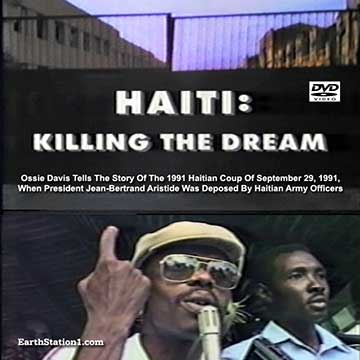
August 23: The International Day For
Remembrance Of The Slave Trade And its Abolition: -- July 22-23,
1791-The Age Of Enlightenment (The Enlightenment, The Age Of
Reason): The Age Of Revolution: The Atlantic Revolutions: The
French Revolution: The French Revolutionary And Napoleonic Wars
(The Great French War) (The French Revolutionary Wars, The
Napoleonic Wars): Slavery: The Atlantic Slave Trade: Slavery In
Haiti And Santo Domingo (1625-1789): Abolitionism: The Haitian
Revolution (French: Revolution Haitienne) (The War Of Independence
(French: La Guerre De L'Independance) [Haitian Creole: Lage D
Lendependans]): -- On this night in 1791, the people of Santo
Domingo (present-day Haiti and the Dominican Republic) began an
uprising unlike any the world had seen. The slave population of
the island - brutally suppressed for centuries - rose up and
fought valiantly for their dignity and freedom from colonialism.
From 1791 to 1804, French and British armies suffered tremendous
losses at the hands of the Haitian people. In 1804, Haiti became
independent from France, effectively abolishing the horrors of the
transatlantic slave trade. The International Day For Remembrance
Of The Slave Trade And its Abolition was designated by UNESCO as
an international day to commemorate this day and to memorialize
the transatlantic slave trade. UNESCO Member States organize
events every year on that date, inviting participation from young
people, educators, artists and intellectuals. As part of the goals
of the intercultural UNESCO project, "The Slave Route",
it is an opportunity for collective recognition and focus on the
"historic causes, the methods and the consequences" of
slavery. Additionally, it sets the stage for analysis and dialogue
of the interactions which gave rise to the transatlantic trade in
human beings between Africa, Europe, the Americas and the
Caribbean. On Sale @ 15% Off Discount Till Midnight PT!
https://store.earthstation1.com/haiti-killing-the-dream-the-1991-haitian-coup-dvd-download1991.html
Today's
EarthStation1.com 15% (Or More!) Off Commemorative Memorial Title:
The Battle Of Kursk: The Mother Of All Battles WWII DVD MP4 USB
Drive
Today, August 23, 2026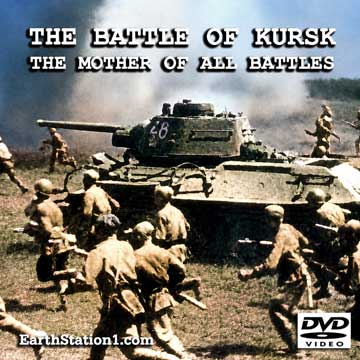
August 23: Russian Day Of Military
Honour: Victory Over Germany In The Battle Of Kursk, 1943: -- The
European Civil War: World War II: The Second European War (The
European Theater Of World War II): The Eastern Front Of World War
II: The Great Patriotic War (The German-Soviet War): The Battle Of
Kursk (Russian: Kurskaya Bitva): -- Kharkiv, the second-largest
city in Ukraine, is liberated as a result of the Battle Of Kursk.
The Days Of Military Honour are special memorable dates in the
Russian Armed Forces dedicated to the most outstanding victories
won by Russia. Some of these dates are state holidays but the
majority of them is celebrated purely in the military. On July 5,
1943, German forces began a massive offensive against the Soviet
Union at the Battle Of Kursk, the largest full-scale battle in
history and the world's largest tank battle, also known as
Operation Citadel. The battle broke the back of the German
Wehrmacht, and from then on, Germany's war fortunes turned against
them. The day prior, July 4, 1943, preliminary combat began in
Prokhorovka village. The fighting started on the southern face of
the salient on the evening of 4 July 1943, when German infantry
launched attacks to seize high ground for artillery observation
posts prior to the main battle that began on 5 July. During these
attacks, a number of Red Army command and observation posts along
the first main belt of defence were captured. By 16:00 on 4 July,
elements of the Panzergrenadier Division "Grossdeutschland",
3rd and 11th Panzer Divisions had seized the village of Butovo and
proceeded to capture Gertsovka before midnight. At around 22:30,
Russian General Vatutin ordered 600 guns, mortars and Katyusha
rocket launchers, of the Voronezh Front, to bombard the forward
German positions, particularly those of the II SS Panzer Corps.
The Battle Of Kursk was a Second World War engagement between
German and Soviet forces on the Eastern Front near Kursk (450
kilometres or 280 miles south-west of Moscow) in the Soviet Union,
during July and August 1943. After preliminary engagements of 4
July in and around Prokhorovka village, the main Battle Of Kursk
began with the launch of the German offensive, Operation Citadel
(German: Unternehmen Zitadelle), on 5 July, which had the
objective of pinching off the Kursk salient with attacks on the
base of the salient from north and south simultaneously. After the
German offensive stalled on the northern side of the salient, on
12 July the Soviets commenced their Kursk Strategic Offensive
Operation with the launch of Operation Kutuzov against the rear of
the German forces in the northern side. On the southern side, the
Soviets also launched powerful counterattacks the same day, one of
which led to a large armoured clash, the Battle of Prokhorovka. On
3 August, the Soviets began the second phase of the Kursk
Strategic Offensive Operation with the launch of Operation
Polkovodets Rumyantsev against the German forces in the southern
side of the Kursk salient. The battle was the final strategic
offensive that the Germans were able to launch on the Eastern
Front. Because the Allied invasion of Sicily had begun, Adolf
Hitler was forced to have troops training in France diverted to
meet the Allied threat in the Mediterranean, rather than use them
as a strategic reserve for the Eastern Front. Hitler canceled the
offensive at Kursk after only a week, in part to divert forces to
Italy, resulting in a reduction of German strength on the Eastern
Front. Germany's extensive losses of men and tanks ensured that
the victorious Soviet Red Army enjoyed the strategic initiative
for the remainder of the war. The Germans hoped to weaken the
Soviet offensive potential for the summer of 1943 by cutting off
the forces that they anticipated would be in the Kursk salient.
The Kursk salient or bulge was 250 kilometres (160 mi) long from
north to south and 160 kilometres (99 mi) from east to west. The
plan envisioned an envelopment by a pair of pincers breaking
through the northern and southern flanks of the salient. Hitler
believed that a victory here would reassert German strength and
improve his prestige with his allies, who were considering
withdrawing from the war. It was also hoped that large numbers of
Soviet prisoners would be captured to be used as slave labour in
the German armaments industry. The Soviet government had
foreknowledge of the German intentions, provided in part by the
British intelligence service's overall intelligence gatherings and
their cryptanalysis of intercepted Lorenz cipher German Army
communications, known as Tunny Intercepts, co-called because
British cryptanalysts, who referred to encrypted German
teleprinter traffic as Fish, dubbed the machine and its traffic
Tunny (meaning tunafish). Aware months in advance that the attack
would fall on the neck of the Kursk salient, the Soviets built a
defence in depth designed to wear down the German armoured
spearhead. The Germans delayed the offensive while they tried to
build up their forces and waited for new weapons, mainly the new
Panther tank but also larger numbers of the Tiger heavy tank. This
gave the Red Army time to construct a series of deep defensive
belts. The defensive preparations included minefields,
fortifications, artillery fire zones and anti-tank strong points,
which extended approximately 300 km (190 mi) in depth. Soviet
mobile formations were moved out of the salient and a large
reserve force was formed for strategic counter-offensives. The
Battle Of Kursk was the first time in the Second World War that a
German strategic offensive was halted before it could break
through enemy defences and penetrate to its strategic depths. The
maximum depth of the German advance was 8-12 kilometres (5.0-7.5
mi) in the north and 35 kilometres (22 mi) in the south. Though
the Red Army had succeeded in winter offensives previously, their
counter-offensives following the German attack at Kursk were their
first successful strategic summer offensives of the war. On Sale
Until Midnight Tonight PT!
https://store.earthstation1.com/the-battle-of-kursk-the-mother-of-all-battles-wwii-dvd-mp4-usb-driv4.html
Today's
EarthStation1.com 15% (Or More!) Off Commemorative Memorial Title:
The Road To War: Years Between WWI & WWII TV Series DVD,
Download, USB
Today, August 23, 2026
August 23: Black Ribbon Day (The European
Day Of Remembrance For Victims Of Stalinism And Nazism): -- A day
is set aside to remember the victims of Stalinism posed by then
Union Of Soviet Socialist Republics (U.S.S.R.) leader Joseph
Stalin and those of Nazism posed by German dictator Adolf Hitler.
August 23, 1939, was when The Molotov-Ribbentrop Pact was signed.
The agreement was between the Soviet Union and Germany. Shortly
after it was signed, the Second World War began. The day is to
remember the victims of the horrendous acts that occurred during
those times. European Day of Remembrance for Victims of Stalinism
and Nazism is one of the two days observed by the European Union
alongside Europe Day. The day symbolizes the rejection of
extremism, intolerance, and oppression according to the European
Union and its purpose is to preserve the memory of the victims of
mass deportations and exterminations while promoting democratic
values to reinforce peace and stability in Europe. Black Ribbon
Day originated during the era of the Cold War in the 1980s. The
refugee communities in Western countries such as the U.S. and
Canada marked this day to remember atrocities by the communist
regime in Russia that led to the Revolution of 1989. Markus Hess
of the Estonian Central Council in Canada coined the name 'Black
Ribbon Day' where a ribbon was used during protest. From that year
on, the agitation was not just held in North America but spread to
Europe and the Baltic countries. It was officially recognized by
the European Union later. The European Day of Remembrance for
Victims of Stalinism and Nazism was made official by the European
Parliament in September 2008. The first formal commemoration of
this day started in 2011 in Warsaw, Poland. The unspeakable acts
that took place during the Stalinism and Nazism regimes should not
be forgotten to remind everyone never to go back. Nazism was known
for its oppressive rule and attempting to eradicate a whole race
of people simply because they felt they were inferior, leading to
what we now know as the 'holocaust,' killing about two-thirds of
Europe's Jewish population. On Sale Until Midnight Tonight PT!
https://store.earthstation1.com/the-road-to-war-dvd-set-all-8-tv-shows-4-dis84.html
Today's
EarthStation1.com 15% (Or More!) Off Commemorative Memorial Title:
The Second Russian Revolution TV Series DVD, Video Download, USB
Drive
Today, August 23, 2026
August 23: The Day Of The National Flag
(Ukraine): -- This holiday was established to honor the
centuries-old history of Ukrainian state development, the state
symbols of independent Ukraine, and to educate citizens to respect
their national symbols. After the proclamation of the independence
of Ukraine in 1991, national symbols - anthem, flag, and coat of
arms - began to guard the establishment of independence and
sovereignty of the state. Researchers of the history of Ukraine
found that these two colors - blue and yellow - were from the time
of Kievan Rus. The use of yellow and blue colors on flags of
Ukraine is traced to the adoption of Christianity. In later times,
the forms and colors of flags were diversified, and additional
images and inscriptions appeared. The development of the "Cossack"
had a significant influence on the Ukrainian flag. When the
monarchs hired the "Cossacks" for military battles, they
presented them with jewels - which remained and were later used by
the Cossacks. Zaporizhzhia was represented by a flag. The
"Zaporizhzhya Sich Great Ensign" was crimson with a
depiction of the 'White Archangel Michael' on the front and a
white Greek cross surrounded by golden skies on the reverse. The
city of Zaporizhzhia was also the birthplace of the Ukrainian
maritime flag. In the second half of the 20th century, blue-yellow
passed the path of national recognition and legal registration.
There were singular attempts to bring the Ukrainian flag. The
issue of national symbols -in particular the flag - has repeatedly
raised democratic forces. At the time of the proclamation of
Ukraine's independence, the national blue-yellow flag was already
hanging over many Ukrainian cities and villages. In July 1990,
this flag was raised during a meeting of The Verkhovna Rada Of
Ukraine (Verkhovna Rada, Rada, VR), the unicameral parliament of
Ukraine, and then it was also raised over Khreshchatyk, the main
street of Kyiv. Thus, on September 4, 1991, after the proclamation
of Ukraine's independence, the national blue-yellow flag was
raised over The Verkhovna Rada Building where Verkhovna Rada now
meets for all regular and ceremonial sessions. On Sale Until
Midnight Tonight PT!
https://store.earthstation1.com/the-second-russian-revolution-6-dvd-set-complete-tv-serie6.html
Today's
EarthStation1.com 15% (Or More!) Off Commemorative Memorial Title:
You Are There Radio Historical Drama Series MP3 CD, Download, USB
Today, August 23, 2026
August 23, 79 AD: Natural Disasters:
Volcanoes: Volcanic Eruptions: Ancient Volcanic Eruptions:
Volcanic Eruptions In Italy: Mount Vesuvius: Eruptions Of Mount
Vesuvius: The Eruption Of Mount Vesuvius In 79 AD: -- Mount
Vesuvius in Campania on the Gulf of Naples in southern Italy
begins to stir on the feast day of Vulcan, the Roman god of fire
after whom volcanoes are ultimately named. Of the many eruptions
of this major stratovolcano (composite volcano), the best-known,
and one of the deadliest, eruptions of Mount Vesuvius occurred in
79 AD, when Vesuvius violently spewed forth a cloud of
super-heated tephra and gases to a height of 33 km (21 mi),
ejecting molten rock, pulverized pumice and hot ash at 1.5 million
tons per second, ultimately releasing 100,000 times the thermal
energy of the atomic bombings of Hiroshima and Nagasaki. The event
gives its name to the Vesuvian type of volcanic eruption,
characterised by columns of hot gases and ash reaching the
stratosphere, although the event also included pyroclastic flows
associated with Pelean eruptions. The event destroyed several
Roman towns and settlements in the area. Pompeii, Stabiae and
Herculaneum, obliterated and buried underneath massive pyroclastic
surges and ashfall deposits, are the most famous examples.
Archaeological excavations have revealed much of the towns and the
lives of the inhabitants leading to the area becoming the Vesuvius
National Park and a UNESCO World Heritage Site. The total
population of both cities was over 20,000. The remains of over
1,500 people have been found at Pompeii and Herculaneum so far,
although the total death toll from the eruption remains unknown.
The dating of this eruption has always been problematic. It is
mentioned in first-century Roman sources, but not the day of the
eruption. For example, Josephus in his Antiquities of the Jews
mentions that the eruption occurred "in the days of Titus
Caesar." Suetonius, a second-century historian, in his Life
of Titus simply says that, "There were some dreadful
disasters during his reign, such as the eruption of Mount Vesuvius
in Campania." Writing well over a century after the actual
event, Roman historian Cassius Dio (as translated in the Loeb
Classical Library 1925 edition) wrote that, "In Campania
remarkable and frightful occurrences took place; for a great fire
suddenly flared up at the very end of the summer." For more
than five centuries, until approximately 2018, articles about the
eruption of Vesuvius typically stated that the eruption began on
August 24 of 79 AD. This date came from a 1508 printed copy of a
letter addressed by Pliny the Younger to the Roman historian
Tacitus, originally written some 25 years after the event. Pliny
was a witness to the eruption and provided the only known
eyewitness account. Over fourteen centuries of manuscript
hand-copying up to the 1508 printing of his letters, the date
given in Pliny's original letter may have been corrupted.
Manuscript experts believe that the date originally given by Pliny
was one of August 24, October 30, November 1, or November 23. This
odd scattered set of dates is due to the Romans' convention for
describing calendar dates. The large majority of extant medieval
manuscript copies - there are no surviving Roman copies - indicate
a date corresponding to August 24. Since the discovery of the
cities, this was accepted by most scholars and by nearly all books
written about Pompeii and Herculaneum for the general public.
Since at least the late 18th century, a minority among
archaeologists and other scientists have suggested that the
eruption began after August 24, during the autumn, perhaps in
October or November. In 1797 the researcher Carlo Rosini reported
that excavations at Pompeii and Herculaneum had uncovered traces
of fruits and braziers indicative of autumn, not the summer. More
recently, in 1990 and 2001, archaeologists discovered more
remnants of autumnal fruits (such as the pomegranate), the remains
of victims of the eruption in heavy clothing, and large
earthenware storage vessels laden with wine (at the time of their
burial by Vesuvius). The wine-related discovery suggests that the
eruption might have happened after the grape harvest. In 2007, a
study of prevailing winds in Campania showed that the
southeasterly debris pattern of the first-century eruption is
quite consistent with an autumn event and inconsistent with an
August date. During June, July, and August, the prevailing winds
flow to the west - an arc between the southwest and northwest -
virtually all the time. As Emperor Titus of the Flavian dynasty
(reigning June 24, 79 to September 13, 81) garnered victories on
the battlefield (including his capture of the Temple of Jerusalem)
and other honors, his administration issued coins enumerating his
ever-growing accolades. Given the limited space on each coin, his
achievements were stamped on the coins using an arcane encoding.
Two of these coins, from early in Titus' reign, were found in a
hoard recovered at Pompeii's House of the Golden Bracelet.
Although the coins' minting dates are somewhat in dispute, a
numismatic expert at the British Museum, Richard Abdy, concluded
that the latest coin in the hoard was minted on or after June 24
(the first date of Titus' reign) and before September 1 of 79 AD.
Abdy states that it is "remarkable that both coins will have
taken just two months after minting to enter circulation and reach
Pompeii before the disaster." In October 2018, Italian
archaeologists uncovered a charcoal inscription reading "the
16th day before the calends of November," dated October 17
(of 79 AD as it was unlikely to have been a year old) which sets
the earliest possible date for the eruption. A collaborative study
in 2022 has determined a date of October 24-25. On Sale Until
Midnight Tonight PT!
https://store.earthstation1.com/you-are-there-historical-old-time-radio-mp3-c3.html
Today's
EarthStation1.com 15% (Or More!) Off Commemorative Memorial Title:
American Revolutionary War Documentaries DVD, Download, USB Drive
Today, August 23, 2026
August 23, 1775: The Age Of Enlightenment
(The Enlightenment, The Age Of Reason): The Age Of Revolution: The
Atlantic Revolutions: The American Enlightenment: The American
Revolution: The American Revolutionary War: The Battle Of Bunker
Hill: The Proclamation Of Rebellion (A Proclamation For
Suppressing Rebellion And Sedition): -- In response to the news of
the Battle Of Bunker Hill at the outset of what became The
American Revolutionary War, King George III delivers his
Proclamation Of Rebellion to the Court of St James, stating that
the American colonies have proceeded to a state of "open and
avowed rebellion". The Proclamation Of Rebellion ordered
officials of the British Empire "to use their utmost
endeavours to withstand and suppress such rebellion". The
Proclamation also encouraged subjects throughout the Empire,
including those in Great Britain, to report anyone carrying on
"traitorous correspondence" with the rebels so that they
could be punished. The Proclamation was written before Colonial
Secretary Lord Dartmouth had been given a copy of the Olive Branch
Petition from the Continental Congress. Because the king refused
to receive the petition, the Proclamation effectively served as an
answer to the petition. On October 27, 1775, North's Cabinet
expanded on the Proclamation in the Speech from the Throne read by
the King at the opening of Parliament. The speech insisted that
rebellion was being fomented by a "desperate conspiracy"
of leaders whose claims of allegiance to him were insincere; what
the rebels really wanted, he said, was to create an "independent
Empire". The speech indicated that the King intended to deal
with the crisis with armed force, and was even considering
"friendly offers of foreign assistance" to suppress the
rebellion without pitting Briton against Briton. A pro-American
minority in Parliament warned that the government was driving the
colonists towards independence, something that many colonial
leaders had insisted they did not desire. The Second Continental
Congress issued a response to the Proclamation on December 6,
saying that while they had always been loyal to the king, the
British Parliament never had any legitimate claim to authority
over them, because the colonies were not democratically
represented. Congress argued that it was their duty to continue
resisting Parliament's violations of the British Constitution, and
that they would retaliate if any supporters in Great Britain were
punished for "favouring, aiding, or abetting the cause of
American liberty". Congress maintained that they still hoped
to avoid the "calamities" of a "civil war".
The Proclamation and the Speech from the Throne undermined
moderates in the Continental Congress such as John Dickinson, who
had been arguing that the king would find a way to resolve the
dispute between the colonies and Parliament. When it became clear
that the king was not inclined to act as a conciliator, colonial
attachment to the Empire was weakened, and a movement towards
declaring independence became a reality, culminating in the United
States Declaration Of Independence on July 4, 1776. On Sale Until
Midnight Tonight PT!
https://store.earthstation1.com/american-revolutionary-war-dvd-documentaries.html
Today's
EarthStation1.com 15% (Or More!) Off Commemorative Memorial Title:
The Guns Of August (1964) WWI Film DVD, Video Download, USB Drive
Today, August 23, 2026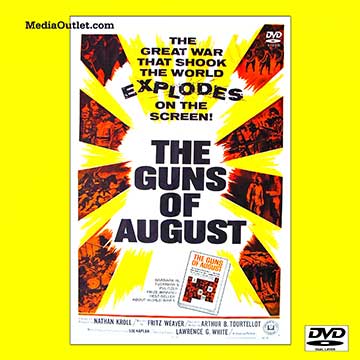
August 23, 1914: The European Civil War:
World War I: The First European War (The European Theater Of World
War I): The Guns Of August: The Western Front Of World War I: The
Battle Of Mons: The Great Retreat (French: "La Grande
Retraite", The Retreat From Mons): -- In perhaps the most
important turning point of the First World War, the first major
action of the British Expeditionary Force (BEF) in the First World
War, the British Army valiantly attempts to hold the line of the
Mons-Conde Canal against the advancing German 1st Army, and though
the British fought well and inflicted disproportionate casualties
on the numerically superior Germans, they were eventually forced
to retreat due both to the greater strength of the Germans and the
sudden retreat of the French Fifth Army, which retreat exposed the
British right flank, resulting in what was initially planned as a
simple tactical withdrawal, which was executed in good order, the
British retreat from Mons ultimately became known as The Great
Retreat, which lasted for two weeks, and took the BEF to the
outskirts of Paris before it counter-attacked in concert with the
French, at The Battle Of The Marne. The Great Retreat was the
culmination of Allied defeats by the Imperial German armies at
both The Battle Of Charleroi (August 21) and The Battle Of Mons
(August 23). On Sale Until Midnight Tonight PT!
https://store.earthstation1.com/the-guns-of-august-dvd-1964-world-war-i-movie-documen1964.html
Today's
EarthStation1.com 15% (Or More!) Off Commemorative Memorial Title:
Hollywood (1980) Silent Movie History Series DVD, Video Download,
USB
Today, August 23, 2026
August 23: National Valentino Day: --
Although the era of monochrome movies is long gone, the symbol
that is Rudolph Valentino is here to stay, providing an
opportunity to celebrate one of the leading faces in the movie
industry. Rudolph Valentino was a 1920s film star who passed away
on August 23, 1926. Movies like "The Four Horsemen of the
Apocalypse," "The Eagle," "The Sheik,"
"Blood and Sand," and "The Son of the Sheik"
are some of the legacies he left behind. In the world of black and
white silent movies, it is not an easy task to stand out or make
an impression. However difficult it was, Valentino Day is proof
that difficult does not mean impossible. Rudolph Valentino was
born in Castellaneta, Apulia, in the Kingdom of Italy and named
Rodolfo Pietro Filiberto Raffaello Guglielmi di Valentina
d'Antonguella. Due to his exceptional looks and playful
personality, Valentino grew to become the first male Hollywood sex
symbol of his day. He went from bussing tables and gardening to
dancing, even becoming a taxi driver, before joining a production
company, and finally trying a career in cinema in the silent film
era. His first part was as an extra in the film "Alimony".
By 1919, he had appeared in bit parts but had not yet reached the
point of stardom, until his lead role in the movie "The Four
Horsemen of the Apocalypse." This became one of the first to
make 1M USD at the Box Office and the sixth highest-grossing
silent movie ever. In 1921, Valentino solidified his reputation as
the Latin lover in "The Sheik." The success of this
movie shaped his career. In 1922, Valentino worked on "Blood
and Sand", one of the four top-grossing movies of that year,
after which, he landed a lucrative deal with United Artists, where
he went on to star in his other hits such as, "The Eagle"
and "The Son of the Sheik." Rudolph Valentino was a man
of great talent and skill. On August 15, 1926, he collapsed and
was diagnosed with appendicitis and gastric ulcers. His condition
was referred to as Valentino's syndrome - perforated ulcers
mimicking appendicitis. After surgery, Valentino developed
peritonitis. His condition worsened, leading to his early demise
on August 23 of that year at the age of 31. National Valentino Day
is set aside to commemorate his legacy. On Sale Until Midnight
Tonight PT!
https://store.earthstation1.com/hollywood-1980-tv-documentary-series-13-shows-4-dual-lay1980134.html
Today's
EarthStation1.com 15% (Or More!) Off Commemorative Memorial Title:
Clive James' Fame In The 20th Century TV Series DVD Set MP4 USB
Drive
Today, August 23, 2026
August 23, 1926: #DOTD: #RIP: Rudolph
Valentino, Italian actor, film star, cultural icon and sex symbol
(b. May 6, 1895) #dies at the age of 31 of pleuritis (pleurisy,
inflammation surrounding the lungs) caused by sepsis (overwhelming
response to infection) at the New York Polyclinic Hospital in New
York City, after surgery for what would eventually be referred to
as "Valentino's Syndrome" (perforated ulcers mimicking
appendicitis). This untimely death caused mass hysteria among his
female fans and further propelled him to iconic status, ultimately
becoming one of the most important media events in history.
Suicides of despondent fans were reported. Windows were smashed as
fans tried to get in and an all-day riot erupted on August 24.
Over 100 mounted officers and NYPD's Police Reserve were used to
restore order. A phalanx of officers lined the streets for the
remainder of the viewing, as an estimated 100,000 people lined the
streets of Manhattan to pay their respects at his funeral, handled
by the Frank Campbell Funeral Home. Shortly before his death,
Valentino was dating Ziegfeld Follies showgirl Marion Wilson Benda
while he was also involved in a relationship with Polish actress
Pola Negri. Upon his death, Negri made a scene at his funeral,
claiming they had been engaged, in spite of the fact that
Valentino had never mentioned this engagement to anyone himself.
Negri collapsed in hysterics while standing over the coffin, and
Campbell hired four actors to impersonate a Fascist Blackshirt
honor guard, purportedly sent by Benito Mussolini. Media reports
that the body on display in the main salon was not Valentino but a
decoy were continually denied by Campbell. Valentino's funeral
mass in Manhattan was held on Monday, August 30 at Saint Malachy's
Roman Catholic Church, often called "The Actor's Chapel",
as it is located on West 49th Street in the Broadway theater
district, and has a long association with show-business figures.
After Valentino's remains were taken by train from New York to
California, a second funeral was held on the West Coast, at the
Catholic Church of the Good Shepherd in Beverly Hills. Valentino
had no final burial arrangements and his friend June Mathis
arranged a temporary solution when she offered a crypt that she
had purchased for the husband that she had since divorced.
Coincidentally, she died the following year and was interred in
the adjoining crypt that she had purchased for herself; Valentino
was never moved to a new location and he remained in the crypt
next to Mathis. The two are still interred side by side at
Hollywood Forever Cemetery (originally Hollywood Memorial Park
Cemetery) in Hollywood, California. Rudolph Valentino was born
Rodolfo Pietro Filiberto Raffaello Guglielmi di Valentina
d'Antonguolla in Castellaneta, Apulia (Puglia), the "boot
heel" region of Italy. He was a naturalized American who
starred in several well-known silent films including The Four
Horsemen of the Apocalypse, The Sheik, Blood and Sand, The Eagle,
and The Son of the Sheik. He was an early pop icon, a sex symbol
of the 1920s, who was known as "The Latin Lover" or
simply as "Valentino". On Sale Until Midnight Tonight
PT!
https://store.earthstation1.com/clive-james39-fame-in-the-20th-century-tv-series-dvd-set-mp4-usb-39204.html
Today's
EarthStation1.com 15% (Or More!) Off Commemorative Memorial Title:
The Age Of Ballyhoo: The 1920s With Gloria Swanson DVD, Download,
USB
Today, August 23, 2026
August 23, 1927: Anti-Communism In The
United States: Red Scare: The First Red Scare: Sacco And Vanzetti:
The Execution Of Sacco And Vanzetti: -- #DOTD: #RIP: Italian
immigrants Nicola Sacco and Bartolomeo Vanzetti are electrocuted
inside a prison at Charlestown, Massachusetts They had been
convicted of a shoe factory payroll robbery during which the
paymaster and a guard had been killed. Following their
convictions, all appeals for a new trial had failed, despite the
lack of hard evidence and a later admission by a known criminal
that he had participated in the robbery with an organized criminal
gang. The days and weeks leading up to their execution aroused
worldwide protests amid accusations of unfair treatment because
they had radical political views (both men adhered to an anarchist
movement that advocated relentless warfare against a violent and
oppressive government) and were Italian. On Sale Until Midnight
Tonight PT!
https://store.earthstation1.com/the-age-of-ballyhoo-dvd-1920s-documentary-gloria-swa1920.html
Today's
EarthStation1.com 15% (Or More!) Off Commemorative Memorial Title:
Prelude To War: Events Directly Leading To WWII DVD, MP4, USB
Drive
Today, August 23, 2026
August 23, 1939: The Interwar Period (The
Interbellum, Between The Wars): The Road To War: The European
Civil War: World War II: The Second European War (The European
Theater Of World War II): The Diplomatic History Of World War II:
The Molotov-Ribbentrop Pact (The Treaty Of Non-Aggression Between
Germany And The Union Of Soviet Socialist Republics): -- Nazi
Germany and the Soviet Union sign a non-aggression treaty, the
Molotov-Ribbentrop Pact. In a secret addition to the pact, the
Baltic states, Finland, Romania, and Poland are divided between
the two nations. The Molotov-Ribbentrop Pact, also known as the
Nazi-Soviet Pact, the German-Soviet Nonaggression Pact or the Nazi
German-Soviet Pact of Aggression (officially: Treaty of
Non-aggression between Germany and the Union Of Soviet Socialist
Republics), was a neutrality pact between Nazi Germany and the
Soviet Union signed in Moscow by foreign ministers Joachim von
Ribbentrop and Vyacheslav Molotov, respectively. The pact was
followed by the German-Soviet Commercial Agreement in February
1940. The pact delineated the spheres of interest between the two
powers, confirmed by the supplementary protocol of the
German-Soviet Frontier Treaty amended after the joint Invasion Of
Poland. It remained in force for nearly two years, until the
German government of Adolf Hitler ended the pact by launching an
attack on the Soviet positions in Eastern Poland during Operation
Barbarossa on 22 June 1941. The clauses of the Nazi-Soviet Pact
provided a written guarantee of non-belligerence by each party
towards the other, and a declared commitment that neither
government would ally itself to, or aid, an enemy of the other
party. In addition to stipulations of non-aggression, the treaty
included a secret protocol that divided territories of Poland,
Lithuania, Latvia, Estonia, Finland, and Romania into German and
Soviet "spheres of influence", anticipating "territorial
and political rearrangements" of these countries. Thereafter,
Germany invaded Poland on 1 September 1939. Soviet Union leader
Joseph Stalin ordered the Soviet Invasion Of Poland on 17
September, one day after a Soviet-Japanese ceasefire at the
Khalkhin Gol came into effect. In March 1940, parts of the Karelia
and Salla regions in Finland were annexed by the Soviet Union
after the Winter War. This was followed by Soviet annexations of
Estonia, Latvia, Lithuania, and parts of Romania (Bessarabia,
Northern Bukovina, and the Hertza region). Advertised concern
about ethnic Ukrainians and Belarusians had been proffered as
justification for the Soviet Invasion Of Poland. Stalin's invasion
of Bukovina in 1940 violated the pact, as it went beyond the
Soviet sphere of influence agreed with the Axis. The territories
of Poland annexed by the Soviet Union after the 1939 Nazi-Soviet
Invasion Of Poland remained in the USSR at the end of World War
II. The new border was set up along the Curzon Line. Only the
region around Bialystok and a small part of Galicia east of the
San river around Przemysl were returned to the Polish state from
that line. Of all other territories annexed by the USSR in
1939-40, the ones detached from Finland (Karelia, Petsamo),
Estonia (Ingrian area and Petseri County) and Latvia (Abrene)
remain part of the Russian Federation, the successor state of the
USSR upon the Dissolution Of The Soviet Union in 1991. The
territories annexed from Romania had also been integrated into the
Soviet Union (as the Moldavian SSR, or oblasts of the Ukrainian
SSR); nowadays, the core of Bessarabia forms Moldova, while the
northern part of Bessarabia, Northern Bukovina, and Hertza form
the Chernivtsi Oblast of Ukraine, and Southern Bessarabia is part
of the Odessa Oblast, also in Ukraine. After the war, von
Ribbentrop was convicted of war crimes and executed. Molotov died
aged 96 in 1986, five years before the USSR's dissolution. The
existence of the secret protocol was denied by the Soviet
government until 1989, when it was finally acknowledged and
denounced. On Sale Until Midnight Tonight PT!
https://store.earthstation1.com/prelude-to-war-events-directly-leading-to-wwii-dvd-mp4-us4.html
Today's
EarthStation1.com 15% (Or More!) Off Commemorative Memorial Title:
Turning Points Of Second World War Midway El Alamein Stalingrad
DVD MP4 USB
Today, August 23, 2026
August 23, 1942: The European Civil War:
World War II: The Second European War (The European Theater Of
World War II): The Eastern Front Of World War II: The Great
Patriotic War (The German-Soviet War): The Battle Of Stalingrad:
-- The largest confrontation of World War II, in which Germany and
its allies fought the Soviet Union for control of the city of
Stalingrad (now Volgograd) in Southern Russia, begins, a battle
lasting until February 2, 1943. Marked by fierce close quarters
combat and direct assaults on civilians in air raids, it was the
largest (nearly 2.2 million personnel) and bloodiest (1.8-2
million killed, wounded or captured) battle in the history of
warfare. After their defeat at Stalingrad, the German High Command
had to withdraw vast military forces from the Western Front to
replace their losses. The German offensive to capture Stalingrad
began using the 6th Army and elements of the 4th Panzer Army. The
attack was supported by intensive Luftwaffe bombing that reduced
much of the city to rubble. The fighting degenerated into
house-to-house fighting; both sides poured reinforcements into the
city. By mid-November 1942, the Germans had pushed the Soviet
defenders back at great cost into narrow zones along the west bank
of the Volga River. On November 19, 1942, the Red Army launched
Operation Uranus, a two-pronged attack targeting the weaker
Romanian and Hungarian armies protecting the German 6th Army's
flanks. The Axis forces on the flanks were overrun and the 6th
Army was cut off and surrounded in the Stalingrad area. Adolf
Hitler ordered that the army stay in Stalingrad and make no
attempt to break out; instead, attempts were made to supply the
army by air and to break the encirclement from the outside. Heavy
fighting continued for another two months. By the beginning of
February 1943, the Axis forces in Stalingrad had exhausted their
ammunition and food. The remaining units of the 6th Army
surrendered. The battle lasted five months, one week and three
days. On Sale Until Midnight Tonight PT!
https://store.earthstation1.com/turning-points-of-2nd-world-war-midway-el-alamein-stalingrad-dv2.html
Today's
EarthStation1.com 15% (Or More!) Off Commemorative Memorial Title:
The Satellite Sky: The Space Race DVD, Video Download, USB Flash
Drive
Today, August 23, 2026
August 23, 1966: Outer Space Firsts: The
History Of Rocketry: The History Of Spaceflight: The Aftermath Of
World War II: The Cold War: The Space Age: The Space Race: The
Discovery And Exploration Of The Solar System: Missions To The
Moon: Space Probes: Lunar Space Probes:The United States Space
Program: The Lunar Orbiter Program: Lunar Orbiter 1: -- Lunar
Orbiter 1, the first American spacecraft to orbit the Moon, takes
the first photograph of Earth from lunar orbit. The Lunar Orbiter
1 robotic spacecraft, part of NASA's Lunar Orbiter program, was
launched at 19:31 UTC atop an Atlas SLV-3 Agena-D rocket from Cape
Kennedy Launch Complex 13 (LC-13). It was designed primarily to
photograph smooth areas of the lunar surface for selection and
verification of safe landing sites for the Surveyor and Apollo
missions. It was also equipped to collect selenodetic, radiation
intensity, and micrometeoroid impact data. On Sale Until Midnight
Tonight PT!
https://store.earthstation1.com/the-satellite-sky-dvd-cold-war-space-race-films.html
Today's
EarthStation1.com 15% (Or More!) Off Commemorative Memorial Title:
America: The Second Century Documentary Series DVD, Download, USB
Today, August 23, 2026
August 23, 1970: Labor Union Disputes
(Trade Union Disputes): Strikes (Strike Actions, Labor Strikes,
Labour Strikes): Farmworker Strikes (Farmhand Strikes,
Agricultural Worker Strikes, Agricultural Strikes): The Salad Bowl
Strike: -- In a unique strike action where a labor union struck
against another labor union, The United Farm Workers union stages
a series of strikes, mass pickets, boycotts and secondary
boycotts, organized by Mexican American labor union leader Cesar
Chavez for the United Farm Workers union, the largest farm worker
strike in U.S. history, against the International Brotherhood of
Teamsters. The strike led directly to the passage of the
California Agricultural Labor Relations Act in 1975. By 1969, the
UFW was on the verge of winning its four years old Delano grape
strike. In June 1969, about 25 small growers broke ranks with the
rest of the industry, and by the end of July 1970 the strike had
ended. The UFW believed that success over the Delano grape growers
would lead hundreds of growers to recognize the union and
negotiate contracts with the union. But the UFW was not the only
union to see the end of the Delano grape strike as an opportunity.
Six thousand drivers and packing workers in the Salinas Valley in
California, represented by the Teamsters, struck on July 17, 1970
effectively preventing most of the nation's summer lettuce crop
from reaching consumers. The price of iceberg lettuce tripled
overnight, and thousands of acres of lettuce were plowed under as
crops spoiled on the ground. The strike ended on July 23, but the
contract included a special agreement by the growers to give the
Teamsters, not the UFW, access to farms and the right to organize
workers into unions. The UFW, which had long asserted jurisdiction
over the field workers, was outraged, especially when the
Teamsters signed a contract with the growers days later without
having to do much organizing or build support among the workers.
Even as UFW leader Cesar Chavez went on a hunger strike to protest
the Teamsters' actions and a state district court imposed a
temporary injunction to preempt UFW members from walking off the
job, the UFW held secret talks with the Teamsters to avert a
strike by the UFW. An agreement to return jurisdiction over the
field workers to the farm union was reached on August 12, and
FreshPict Foods (then owned by the Purex Corporation) and
Inter-Harvest (part of the United Fruit Company) broke ranks with
the other lettuce growers and signed contracts with the UFW. But
the August 12 agreement collapsed, and 5,000-7,000 UFW workers
struck the Salinas Valley growers on August 23 in what was the
largest farm worker strike in U.S. history. More workers walked
off the job in the next few weeks, while other unions supported
the strike, shipments of fresh lettuce nationwide almost ceased,
and the price of lettuce doubled almost overnight. Lettuce growers
lost 500K USD a day. A state district court enjoined Chavez
personally and the UFW as an organization from engaging in
picketing, but both Chavez and the union refused to obey the
court's orders. In late September 1970, the UFW asked consumers to
join in a nationwide boycott of all lettuce which had not been
picked by members of the United Farm Workers. Violence, sporadic
at first but increasingly widespread, began to occur in the
fields. On November 4, 1970 a UFW regional office was bombed. On
December 4 federal marshals arrested Chavez and, for the first
time in his life, Cesar Chavez was put in jail. Two days later, he
was visited in the Monterey County jail in Salinas by former
Olympic gold medal-winning decathlete Rafer Johnson and Ethel
Kennedy, widow of slain Senator Robert F. Kennedy. Kennedy and
Johnson were attacked by an anti-union mob on the steps of the
jail, and only intervention by city police, Monterey county
sheriff's deputies, and the Brown Berets prevented a riot and
injury to the visitors. Chavez was released by the Supreme Court
of California on December 23, but the next day called a strike
against six additional lettuce growers. The bitter strike ended on
March 26, 1971 when the Teamsters and UFW signed a new
jurisdictional agreement reaffirming the UFW's right to organize
field workers. The Salad Bowl strike did not end the
jurisdictional disagreement between the Teamsters and the UFW. The
Teamsters resumed their dispute with the UFW in December 1972,
which led to further extensive disruptions in the state
agricultural industry, mass picketing, mass arrests, and extensive
violence. By April 1973, the UFW was "fighting for our lives"
and threatening to launch a nationwide boycott of any grower which
signed a contract with the Teamsters.] Thousands of UFW members
began picketing in the fields on April 15, 1973. Mass arrests
quickly occurred, and many county jails were soon overflowing with
detainees. The organizing battles between the two unions became
violent with audacious and brutal attacks on UFW members day and
night. The UFW appeared to be losing the battle physically,
legally, and organizationally. The violence worsened; seventy farm
workers were attacked on July 31, a UFW picketer was shot on
August 3, five firebombs were thrown at UFW picket lines on August
9, two UFW members were shot on August 11, and a UFW picketer was
shot to death on August 16, 1973. With the UFW beginning to buckle
under the financial, legal, and organizational stress of the
jurisdictional dispute, Chavez entered into talks with the
Teamsters on August 6 but quit them on August 10. But the
Teamsters, too, had suffered greatly (it is possible that the FBI
still suspected the union of having links with organised crime and
that this was bringing a lot of unwarranted attention focused onto
The Mob), and the day after the peace talks ended the Teamsters
shocked other unions and many growers by repudiating all the
contracts they had signed since the new round of battles had
begun. Talks resumed, and a tentative agreement was reached on
September 27, 1973 in which the Teamsters again agreed to leave
jurisdiction over farm field workers to the UFW. By late 1974,
many observers were concluding that the UFW was no longer a viable
force. In July it was forced to end picketing at some grape fields
near Delano. Newspaper columnists suggested in June that the UFW
no longer had any capacity to fight, and by February 1975 had
concluded the union had no future. The ongoing fight between the
Teamsters and UFW and its effect on UFW's organizational viability
led Cesar Chavez to seriously consider and advocate for legal
reform in 1974. Although Jerry Brown had been elected Governor of
California in November 1974, Brown's election was not enough to
win passage of legislation. The UFW knew it had to make a strong
political showing in order to push the California State
Legislature to act. Although it considered mass picketing,
rallies, and more boycotts, the UFW worried that it had lost the
support of farm workers and that such events would only highlight
the union's political weakness. Instead, the UFW settled on a
110-mile (180 km) march by a small group of UFW leaders from San
Francisco to the E & J Gallo Winery in Modesto. The march
would be dramatic, but not require large numbers of participants.
Although just a few hundred marchers left San Francisco on
February 22, 1975, more than 15,000 people had joined them by the
time they reached Modesto on March 1. The dramatic success of the
Modesto march energized the farm labor movement in California, and
Governor Brown quickly began pushing for labor law reform. The
march may have been the capstone, but it was the Delano grape
boycott's success which brought the growers to the table. "The
grape boycott scared the heck out of the farmers, all of us,"
said one major grower. The march brought politicians and the
Teamsters to the table. Broad agreement on a bill was reached on
May 7, 1975 just 68 days after the Modesto march. The California
State Senate passed the bill on May 26, and the California State
Assembly passed the bill two days later. Governor Brown signed the
legislation into law on June 4, 1975. The act went into effect on
August 28, 1975. After hundreds of elections under the law in its
first two years, the UFW and Teamsters finally signed a
long-lasting jurisdictional agreement in March 1977, and the UFW
ended its boycotts of lettuce, grapes, and wine in February 1978.
On Sale Until Midnight Tonight PT!
https://store.earthstation1.com/america-the-second-century-us-2nd-100-years-history-621006.html
Today's
EarthStation1.com 15% (Or More!) Off Commemorative Memorial Title:
The Second Russian Revolution TV Series DVD, Video Download, USB
Drive
Today, August 23, 2026
August 23, 1989: The Aftermath Of World
War II: The Cold War: The Cold War (1985-1991) (The End Of The
Cold War): The Dissolution Of The Soviet Union: The Revolutions Of
1989 (The Fall Of Nations, The Autumn Of Nations, The Fall Of
Communism): The Eastern Bloc (The Communist Bloc, The Socialist
Bloc, The Soviet Bloc): Baltic States Under Soviet Rule: The
Singing Revolution: The Baltic Way (The Baltic Chain, The Chain Of
Freedom): -- In an astounding event, two million people from
Estonia, Latvia and Lithuania stand on the Vilnius-Tallinn road,
holding hands to form a human chain in a peaceful political
demonstration. The Singing Revolution is a commonly used name for
events between 1987 and 1991 that led to the restoration of the
independence of Estonia, Latvia and Lithuania. The term was coined
by an Estonian activist and artist, Heinz Valk, in an article
published a week after the 10-11 June 1988, spontaneous mass
night-singing demonstrations at the Tallinn Song Festival Grounds.
On Sale Until Midnight Tonight PT!
https://store.earthstation1.com/the-second-russian-revolution-6-dvd-set-complete-tv-serie6.html
Today's
EarthStation1.com 15% (Or More!) Off Commemorative Memorial Title:
The Secret Life Of The Video Recorder (VCR, VTR) DVD, MP4, USB
Drive
Today, August 23, 2026
August 23, 1977: Video: The History Of
Video: VHS (Video Home System): -- VHS, the standard for
consumer-level analog video recording on tape cassettes developed
by Victor Company of Japan (JVC) in the early 1970s, is released
in the United States in the form of the worlds's first VHS VCR,
the Victor HR-3300; it had been released in Japan by the president
of JVC on September 9, 1976. JVC started selling the HR-3300 in
Akihabara, Tokyo, Japan on October 31, 1976.Region-specific
versions of the JVC HR-3300 were also distributed later on, such
as the HR-3300U in the United States, and HR-3300EK in the United
Kingdom in January 1977. The United States received its first
VHS-based VCR - the RCA VBT200 on August 23, 1977. The RCA unit
was designed by Matsushita, and was the first VHS-based VCR
manufactured by a company other than JVC. It was also capable of
recording four hours in LP (long play) mode. The United Kingdom
later received its first VHS-based VCR - the Victor HR-3300EK in
1978. Quasar and General Electric would follow-up with VHS-based
VCRs - all designed by Matsushita. By 1999, Matsushita alone
produced just over half of all Japanese VCRs. TV VCR combos,
combining a standard definition CRT TV with a VHS mechanism under
the CRT, were also once available for purchase. The VCR is an
electro-mechanical device that records analog audio and analog
video from television on a removable, magnetic tape videocassette.
Images and sound can then be played back at a more convenient
time. Dr. Norikazu Sawakzaki developed a prototype helical scan
videotape recorder (VTR) in 1953. In 1956, Ampex introduced the
quadruplex videotape professional broadcast standard format with
its Ampex VRX-1000; due to its high 50K USD price, the Ampex
VRX-1000 could be afforded only by the television networks and the
largest individual stations. Many different video recording
systems were developed for home, business and broadcast use during
the 1960s. It was not until 1970 that the Philips "Video
Cassette Recording" (VCR) format was developed as the Philips
N1500, the first home video cassette format player as well as the
first home video cassette format recorder. The home video cassette
market grew slowly but surely as prices dropped and quality
improved throughout the 1970s, '80s, and '90s. At the time, the
VCR was the primary way to watch movies at home. Millions of
people created their own personal movie library. Over 10 billion
videotapes remain today. From the 1950s, magnetic tape video
recording became a major contributor to the television industry,
via the first commercialized video tape recorders (VTRs). At that
time, the expensive devices were used only in professional
environments such as television studios and medical imaging
(fluoroscopy). In the 1970s, videotape entered home use, creating
the home video industry and changing the economics of the motion
picture and television businesses. The television industry viewed
videocassette recorders (VCRs) as having the power to disrupt
their business, while television users viewed the VCR as a means
to take control of their viewing experiences. In the 1970s and
early 1980s, there was a format war in the home video industry.
Two of the standards, VHS and Betamax, received the most media
exposure. VHS eventually won the war, dominating 60 percent of the
North American market by 1980 and emerging as the dominant home
video format throughout the tape media period. After the
introduction of the DVD format in 1996, however, the market share
for VHS began to decline. In 2003, DVD rentals surpassed those of
VHS in the United States and by 2008, DVD had replaced VHS as the
preferred low-end method of distribution. The last known company
in the world to manufacture VHS equipment (VCR/DVD combos), Funai
of Japan, ceased production in July 2016, citing shrinking demand
and difficulties procuring parts. On Sale Until Midnight Tonight
PT!
https://store.earthstation1.com/secret-life-of-the-video-recorder-vcr-vtr-etc-dvd-mp4-us4.html
Today's
EarthStation1.com 15% (Or More!) Off Commemorative Memorial Title:
The Mongol Hordes: Storm From The East TV Series DVD MP4 USB Drive
Today, August 23, 2026
August 23, 1382: The Mongols: The Mongol
Empire: Mongol Invasions And Conquests: The Golden Horde (Kipchak
Turkic: Ulug Ulus "The Great State"): Mongol Invasions
Of The Metropolis Of Kiev And All Rus': The Great Troubles (Church
Slavonic: Velikaya Zamyatnya) (The Golden Horde Dynastic War): The
Mongol Invasions Of The Principality Of Moscow: Sieges Of Moscow:
The Siege Of Moscow 1382: -- The reunified Golden Horde, led by
Tokhtamysh Khan who reunified it, lays siege to the capital of the
Grand Duchy of Moscow with the support of Timur Khan (Tamerlane)
of the Timurid Empire. After uniting the Blue and White Hordes
into the reformed Golden Horde, Tokhtamysh promoted a military
campaign to restore in Russia the power of the tatars, an umbrella
term for different Turkic ethnic groups bearing that name. After
ravaging some small cities, he laid siege to Moscow. However his
attack was beaten off by the Muscovites, who used firearms for the
first time in Russian history. Three days later, two sons of
Tokhtamysh's supporter Dmitry of Suzdal, dukes of Suzdal and
Nizhny Novgorod Vasily and Semyon, who were present in
Tokhtamysh's forces, persuaded Muscovites to open the city gates,
promising that forces would not harm the city in this case. This
allowed Tokhtamysh's troops to burst in and ravage Moscow, killing
around 24,000 people. This defeat reasserted the Horde's rule over
some of Russian lands, which only overthrew Tatar rule 98 years
later, with the Great stand on the Ugra river. Tokhtamysh also
reestablished the Golden Horde as a dominant regional power,
reunifying the Mongol lands from Crimea to Lake Balkash and
defeating Lithuanians at Poltava in the next year. But he made the
disastrous decision to wage a war against his former master
Tamerlane, and the Golden Horde never recovered from that mistake.
On Sale Until Midnight Tonight PT!
https://store.earthstation1.com/the-mongol-hordes-storm-from-the-east-tv-series-dvd-mp4-usb-driv4.html
Today's
EarthStation1.com 15% (Or More!) Off Commemorative Memorial Title:
Monster: A Portrait Of Stalin In Blood TV Series DVD, Download,
USB
Today, August 23, 2026
August 23, 2007: The Aftermath Of World
War I: 20th Century Revolutions: The Revolutions Of 1917-1923: The
Interwar Period (The Interbellum, Between The Wars): The Russian
Revolution: The Execution Of The Romanov Family: -- The skeletal
remains of Russia's last royal family members Alexei Nikolaevich,
Tsarevich of Russia, and his sister Grand Duchess Anastasia are
discovered near Yekaterinburg, Russia. On April 30, 2008, two
skeletal remains found near Yekaterinburg, Russia are confirmed by
Russian scientists to be the remains of Alexei and Anastasia, two
of the children of the last Tsar of Russia, whose entire family
was executed at Yekaterinburg by the Bolsheviks. The Russian
Imperial Romanov family (Tsar Nicholas II, his wife Tsarina
Alexandra and their five children Olga, Tatiana, Maria, Anastasia,
and Alexei) and all those who chose to accompany them into
imprisonment - notably Eugene Botkin, Anna Demidova, Alexei Trupp
and Ivan Kharitonov - were shot, bayoneted and clubbed to death in
Yekaterinburg on the night of 16-17 July 1918 (July 4-5 Julian
calendar date [Russia changed to the Gregorian calendar on
February 1, 1918 Julian/February 14 Gregorian]). The Tsar and his
family were killed by Bolshevik troops led by Yakov Yurovsky under
the orders of the Ural Regional Soviet and according to
instructions by Lenin, Yakov Sverdlov and Felix Dzerzhinsky. Their
bodies were then stripped, mutilated, burned and disposed of in a
field called Porosenkov Log in the Koptyaki forest. Following the
February Revolution, the Romanov family and their loyal servants
were imprisoned in the Alexander Palace before being moved to
Tobolsk and then Ekaterinburg, where they were killed, allegedly
at the express command of Vladimir Lenin. Despite being informed
that "the entire family suffered the same fate as its head",
the Bolsheviks only announced Nicholas's death, with the official
press release that "Nicholas Romanov's wife and son have been
sent to a secure place." For over eight years, the Soviet
leadership maintained a systematic web of disinformation as to the
fate of the family, from claiming in September 1919 that they were
murdered by left-wing revolutionaries to denying outright in April
1922 that they were dead. They acknowledged the murders in 1926
following the publication of an investigation by a White Emigre (a
Russian subject who emigrated from Imperial Russia in the wake of
the Russian Revolution and Russian Civil War, and who was in
opposition to the Bolsheviks who took control of the country after
the revolution), but maintained that the bodies were destroyed and
that Lenin's Cabinet was not responsible. The emergence of Romanov
impostors drew media attention away from Soviet Russia, and
discussion regarding the fate of the family was suppressed by
Joseph Stalin from 1938. The burial site was discovered in 1979 by
amateur sleuth Alexander Avdonin, but the existence of the remains
was not made public until 1989, during the glasnost period. The
identity of the remains was confirmed by forensic and DNA
investigation. They were reburied in the Peter and Paul Cathedral
in Saint Petersburg in 1998, 80 years after they were killed, in a
funeral that was not attended by key members of the Russian
Orthodox Church, who disputed the authenticity of the remains. A
second, smaller grave containing the remains of two Romanov
children missing from the larger grave was discovered by amateur
archaeologists (Dr Alexander Avdonin, Dr Sergei Nikitin and Peter
Sarandinaki) in 2007. However, their remains are kept in a state
repository pending further DNA tests. In 2008, after considerable
and protracted legal wrangling, the Russian Prosecutor General's
office rehabilitated the Romanov family as "victims of
political repressions". A criminal case was opened by the
post-Soviet government in 1993, but nobody was prosecuted on the
basis that the perpetrators were dead. Some historians attribute
the order to the government in Moscow, specifically Yakov Sverdlov
and Vladimir Lenin, who wished to prevent the rescue of the
Imperial Family by the approaching Czechoslovak Legion (fighting
with the White Army against the Bolsheviks) during the ongoing
Russian Civil War. This is supported by a passage in Leon
Trotsky's diary. An investigation led by Vladimir Solovyov
concluded in 2011 that, despite the opening of state archives in
the post-Soviet years, there is yet no written document found that
indicates that either Lenin or Sverdlov instigated the orders;
however, they did endorse the executions after they occurred.
Lenin had close control over the Romanovs although he ensured his
name was not associated with their fate in any official documents.
President Boris Yeltsin described the killings as one of the most
shameful pages in Russian history. On Sale Until Midnight Tonight
PT!
https://store.earthstation1.com/monster-a-portrait-of-stalin-in-blood-dvd-tv-series-2-disc2.html
Today's
EarthStation1.com 15% (Or More!) Off Commemorative Memorial Title:
The Red Bomb Soviet Nuclear Bombs History + 2 Bonuses MP4 Download
DVD
Today, August 23, 2026
August 23, 1953: The Aftermath Of World
War II: The Cold War: The Cold War (1953-1962): Nuclear Warfare:
Nuclear Weapons Testing: Soviet Nuclear Warfare: Soviet Nuclear
Weapons Testing: The Soviet Atomic Bomb Project: The RDS-4 (From
The Soviet Codename For Their Atomic Bombs Reaktivnyy Dvigatel'
Spetsia, "Special Jet Engine"; Russian Codename:
Tatyana): -- The first Soviet mass-produced tactical nuclear
weapon is first tested at the Semipalatinsk Test Site also known
as The Polygon, the primary testing venue for the Soviet Union's
nuclear weapons, located on the steppe in northeast Kazakhstan (in
the former Kazakh SSR. The device weighed approximately 1,200
kilograms (2,646 lb), and was dropped from an IL-28 aircraft at an
altitude of 11 kilometres (7 mi) and exploded at 600 metres (1,969
ft), with a yield of 28 kt. A plutonium bomb, it was nonetheless
virtually identical in its outward appearance to the American
Little Boy uranium bomb, the Soviets having stolen the design for
the bomb largely through the collaboration of Manhattan Project
physicist and Soviet spy Klaus Fuchs. It remained in service until
1966. It used a composite core of 4.2 kilograms (9 lb) Pu-239 and
6.8 kilograms (15 lb) 90% enriched U-235 and had a nominal yield
of 30 kilotons. The bomb was thereafter deployed to be delivered
from a Tu-4 (the reverse-engineered Boeing B-29) and Tu-16 heavy
bomber aircraft. On Sale Until Midnight Tonight PT!
https://store.earthstation1.com/the-red-bomb-soviet-nuclear-weapons-history-tv-series-mp4-download-dv4.html
Today's
EarthStation1.com 15% (Or More!) Off Commemorative Memorial Title:
Medal Of Honor: World War II: Pearl Harbor & Pacific MP4
Download DVD
Today, August 23, 2026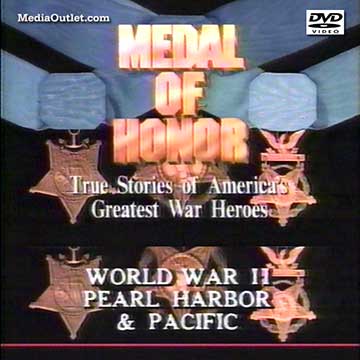
August 23, 1883: #BOTD: #HBD! Jonathan M.
Wainwright, American army general and Freemason, Commander of
American and Filipino forces during the Japanese invasion of the
Philippines, for which he received a Medal of Honor for his
courageous leadership, taken prisoner in May 1942 on the island
stronghold of Corregidor when Allied forces, lacking food,
supplies and ammunition, and bearing mounting casualties,
surrendered the Philippines to the Japanese, the highest-ranking
American prisoner of war during World War II, during World War II,
rescued by the Red Army in Manchukuo, Commander of Allied forces
in the Philippines at the time Japan surrendered to the United
States, witness to the signing of the Japanese surrender
documentent aboard the USS Missouri on September 2, recipient of
one of five pens (along with British Lieutenant General Arthur
Percival) that MacArthur used to sign the document, promoted to
four-star General three days after the Japanese surrender (d.
September 2, 1953) is #born Jonathan Mayhew Wainwright IV in Walla
Walla, Washington. Nicknamed "Skinny" and "Jim",
Jonathan Wainwright was hailed as a hero upon his liberation.
Despite his rank, his treatment at the hands of the Japanese was
no less unpleasant than that of most of his men. When he met
General MacArthur in August 1945 shortly after his liberation, he
had become thin and malnourished from three years of mistreatment
during captivity. Together with British General Arthur Percival,
he returned to the Philippines to receive the surrender of the
local Japanese commander, Lieutenant-General Tomoyuki Yamashita,
to whom General Percival had surrendered in 1942. Dubbed by his
men a "fighting" general who was willing to get down in
the foxholes, Wainwright won the respect of all who were
imprisoned with him. He agonized over his decision to surrender
Corregidor throughout his captivity, feeling that he had let his
country down. Upon release, the first question he asked was how
people back in the U.S. thought of him, and he was amazed when
told he was considered a hero. When he was recommended to receive
the Medal of Honor, an honor which had first been proposed early
in his captivity, it was rejected due to the vehement opposition
of General MacArthur, who felt that Corregidor should not have
been surrendered; MacArthur did not oppose the renewed proposal in
1945. Jonathan M. Wainwright died of a stroke in San Antonio,
Texas, aged 70. Wainwright is buried in Section 1 of Arlington
National Cemetery, next to his wife and near his parents. Present
during the funeral were Omar Bradley, George Marshall and Edward
King, with the conspicuous absence of MacArthur. He was buried
with a Masonic service, and is one of the few people to have had
their funeral held in the lower level of the Memorial
Amphitheater. On Sale Until Midnight Tonight PT!
https://store.earthstation1.com/medal-of-honor-world-war-ii-pearl-harbor-amp-pacific-mp4-download-dv4.html
Today's
EarthStation1.com 15% (Or More!) Off Commemorative Memorial Title:
The American Adventure: TV History Series 1607-1876 DVD MP4 USB
Drive
Today, August 23, 2026
August 23, 1831: Slavery: Slavery In The
United States: Slave Rebellions: Slave Rebellions In The United
States: Nat Turner's Slave Rebellion (The Southampton
Insurrection): -- Day 3 of the 3-Day Nat Turner's Rebellion, also
known as the Southampton Insurrection, a slave rebellion that took
place in Southampton County, Virginia. Led by the African American
slave Nat Turner, fellow rebel slaves killed from 55 to 65 people,
at least 51 being white. The rebellion was put down within a few
days, but Turner survived in hiding for more than two months
afterwards. The rebellion was effectively suppressed at Belmont
Plantation on the morning of August 23, 1831. There was widespread
fear in the aftermath, and white militias organized in retaliation
against the slaves. The state executed 56 slaves accused of being
part of the rebellion, and many non-participant slaves were
punished in the frenzy. Approximately 120 slaves and free blacks
were murdered by militias and mobs in the area. Approximately 250
blacks in total died as a result of the rebellion. State
legislatures passed new laws prohibiting education of slaves and
free black people, restricting rights of assembly and other civil
liberties for free black people, and requiring white ministers to
be present at all worship services. On Sale Until Midnight Tonight
PT!
https://store.earthstation1.com/the-american-adventure-series-us-1st-century-4-dv14.html
Today's
EarthStation1.com 15% (Or More!) Off Commemorative Memorial Title:
British Rock: The First Wave DVD, MP4 Video Download. USB Flash
Drive
Today, August 23, 2026
August 23, 1946: #BOTD: #HBD! Keith Moon,
English drummer, songwriter and producer, extraordinary drummer
for the rock band the Who whose drumming continues to be praised
by critics and musicians, noted for his unique style and his
eccentric, often self-destructive behaviour (d. September 7, 1978)
is #born Keith John Moon at Central Middlesex Hospital in
northwest London, England. Keith Moon was posthumously inducted
into the Modern Drummer Hall of Fame in 1982, becoming only the
second rock drummer to be chosen, and in 2011, Moon was voted the
second-greatest drummer in history by a Rolling Stone readers'
poll. Moon grew up in Alperton, a suburb of Wembley, in Middlesex,
and took up the drums during the early 1960s. After playing with a
local band, the Beachcombers, he joined the Who in 1964 before
they recorded their first single. Moon remained with the band
during their rise to fame, and was quickly recognised for his
drumming style, which emphasised tom-toms, cymbal crashes, and
drum fills. Throughout Moon's tenure with the Who his drum kit
steadily grew in size, and along with Ginger Baker, Moon has been
credited as one of the earliest rock drummers to regularly employ
double bass drums in his setup. He occasionally collaborated with
other musicians and later appeared in films, but considered
playing in the Who his primary occupation and remained a member of
the band until his death. In addition to his talent as a drummer,
however, Moon developed a reputation for smashing his kit on stage
and destroying hotel rooms on tour. He was fascinated by blowing
up toilets with cherry bombs or dynamite, and by destroying
television sets. Moon enjoyed touring and socialising, and became
bored and restless when the Who were inactive. His 21st birthday
party in Flint, Michigan, has been cited as a notorious example of
decadent behaviour by rock groups. Moon suffered a number of
setbacks during the 1970s, most notably the accidental death of
chauffeur Neil Boland and the breakdown of his marriage. He became
addicted to alcohol, particularly brandy and champagne, and
acquired a reputation for decadence and dark humour; his nickname
was "Moon the Loon." After moving to Los Angeles with
personal assistant Peter "Dougal" Butler during the
mid-1970s, Moon recorded his only solo album, the poorly received
Two Sides of the Moon. While touring with the Who, on several
occasions he passed out on stage and was hospitalised. By their
final tour with him in 1976, and particularly during production of
The Kids Are Alright and Who Are You, the drummer's deterioration
was evident. Moon moved back to London in 1978, dying in September
of that year from an overdose of Heminevrin, a drug intended to
treat or prevent symptoms of alcohol withdrawal, after having been
the guest of Paul and Linda McCartney at the preview of Paul's
film The Buddy Holly Story and dining with them afterwards at
Peppermint Park in Covent Garden, West End, London, England. Moon
and his partner, swedish model Annette Walter-Lax, returned to
their flat. There they watched the film The Abominable Dr. Phibes,
and Moon asked Walter-Lax to cook him steak and eggs. When she
objected, Moon replied, "If you don't like it, you can fuck
off!" These were his last words. Moon then took some
clomethiazole tablets. When Walter-Lax checked on him the
following afternoon, she discovered he was dead. Who manager Bill
Curbishley phoned the flat at around 5:00 p.m. looking for Moon,
and Dymond gave him the news. Curbishley told Townshend, who
informed the rest of the band. Entwistle was giving an interview
to two journalists when he was interrupted by a phone call with
the news of Moon's death. When asked about the band's future
plans, Entwistle burst into tears and quickly ended the interview.
Moon's death came shortly after the release of Who Are You. On the
album cover, he is straddling a chair to hide his weight gain; the
words "Not to be taken away" are on the back of the
chair. Police determined that there were 32 clomethiafzole pills
in Moon's system. Six were digested, sufficient to cause his
death; the other 26 were undigested when he died. Max Glatt, an
authority on alcoholism, wrote in The Sunday Times that Moon
should never have been given the drug. Moon was cremated on
September 13, 1978 at Golders Green Crematorium in London,
England, and his ashes were scattered in its Gardens of
Remembrance. Keith Moon was posthumously inducted into the Modern
Drummer Hall of Fame in 1982, becoming only the second rock
drummer to be chosen, and in 2011, Moon was voted the
second-greatest drummer in history by a Rolling Stone readers'
poll. On Sale Until Midnight Tonight PT!
https://store.earthstation1.com/british-rock-the-first-wave-dvd.html
Today's
EarthStation1.com 15% (Or More!) Off Commemorative Memorial Title:
The Compleat Beatles Documentary Film DVD, MP4 Download, Flash
Drive
Today, August 23, 2026
August 23, 1966: Aesthetics: Performing
Arts: Premieres: Theatre Premieres: Musical Premieres: United
States Musical Premieres: The Beatles' 1966 US Tour: The Beatles
1966 Shea Stadium Concert: -- A little over a year after their
first triumphant appearance at New York's Shea Stadium, The
Beatles returned for a second time. The concert did not sell out,
with 11,000 of the 55,600 tickets still available. The concert
occurred just over three weeks after the infamous July 29, 1966
publication in America by the American teen magazine Datebook of
the Lennon "More popular than Jesus" and McCartney "It's
[America] a lousy country where anyone black is a dirty nigger!"
interviews that sparked a hostile backlash against the Beatles
throughout America generally and the American South's bible belt
particularly. Nonetheless, The Beatles made more money from their
appearance than they had in 1965, receiving 189K USD - 65 per cent
of the gross takings of 292K USD. George Martin remarked
"Curiously enough the second Shea Stadium concert had about
11,000 seats unsold. So it was a pretty unsettling time. And it
was against this background that they said, 'Right, we definitely
won't do any more. We are going to have a break and then we are
going into the studio to make a record.'" The support acts
were The Remains, Bobby Hebb, The Cyrkle and The Ronettes. The
Beatles performed 11 songs: 'Rock And Roll Music', 'She's A
Woman', 'If I Needed Someone', 'Day Tripper', 'Baby's In Black',
'I Feel Fine', 'Yesterday', 'I Wanna Be Your Man', 'Nowhere Man',
'Paperback Writer', and 'Long Tall Sally'. During the performance
of 'Day Tripper' hundreds of fans broke through barriers and
attempted to reach the stage. They were held back by security
guards and none managed to get close to The Beatles. Straight
after the concert The Beatles flew to Los Angeles. They arrived
the following morning in the early hours and enjoyed a rest day
before flying on to Seattle. On Sale Until Midnight Tonight PT!
https://store.earthstation1.com/the-compleat-beatles-documentary-dvd.html
Today's
EarthStation1.com 15% (Or More!) Off Commemorative Memorial Title:
Hollywood: The Fabulous Era Sound Films Documentary MP4 Download
DVD
Today, August 23, 2026
August 23, 1912: #BOTD: #HBD! Gene Kelly,
American actor of film, stage, and television, dancer, film
director, producer, and choreographer (d. February 2, 1996) is
#born Eugene Curran Kelly in the East Liberty neighborhood of
Pittsburgh, Pennsylvania. He was known for his energetic and
athletic dancing style, his good looks, and the likable characters
that he played on screen. Best known today for his performances in
films such as An American in Paris (1951), Anchors Aweigh (1945)-
for which he was nominated for the Academy Award for Best
Actor-and Singin' in the Rain (1952), he starred in musical films
until they fell out of fashion in the late 1950s. He starred in,
choreographed or directed some of the most well-regarded musicals
of the 1940s and 1950s, debuting with Judy Garland in For Me and
My Gal (1942), and followed by Du Barry Was a Lady (1943),
Thousands Cheer (1943), The Pirate (1948), On the Town (1949), and
It's Always Fair Weather (1955), among others. In his later
career, he starred in two films outside the musical genre: Inherit
the Wind (1960) and What a Way to Go! (1964). Throughout his
career he also directed films (some of which he starred in), most
notably the 1969 film Hello, Dolly!, which was nominated for the
Academy Award for Best Picture. His many innovations transformed
the Hollywood musical, and he is credited with almost
single-handedly making the ballet form commercially acceptable to
film audiences. Kelly received an Academy Honorary Award in 1952
for his career achievements, the same year An American in Paris
won six Academy Awards, including Best Picture. He later received
lifetime achievement awards in the Kennedy Center Honors (1982),
and from the Screen Actors Guild and American Film Institute. In
1999, the American Film Institute also numbered him 15th in their
Greatest Male Stars of Classic Hollywood cinema list. Gene Kelly
died aged 83 in Beverly Hills, California after a series of
strokes disabled him. His body was cremated without a funeral or
memorial service, and his ashes given to his widow Patricia Ward.
On Sale Until Midnight Tonight PT!
https://store.earthstation1.com/hollywood-the-fabulous-era-dvd-talking-picture-history.html
Today's
EarthStation1.com 15% (Or More!) Off Commemorative Memorial Title:
War And Peace In The Nuclear Age TV Series DVD, Download, USB
Drive
Today, August 23, 2026
August 23, 1958: The Aftermath Of World
War II: The Cold War: The Cold War (1953-1962): The Cold War In
Asia: The Cross-Strait Relations (Mainland-Taiwan Relations,
China-Taiwan Relations, Taiwan-China Relations): Taiwan Strait
Crises: The Second Taiwan Strait Crisis (The 1958 Taiwan Strait
Crisis): -- The People's Republic Of China (PRC) begins The Second
Taiwan Strait Crisis with the People's Liberation Army (PLA)
bombardment of the Republic Of China (ROC) controlled island of
Quemoy (Kinmen) in the Taiwan Strait. The PRC shelled the islands
of Kinmen and the nearby Matsu Islands along the east coast of the
PRC to "liberate" Taiwan from the Chinese Nationalist
Party, also called Kuomintang (KMT), and probe the extent of the
United States defense of Taiwan's territory. America was went on
nuclear alert over the matter, and recent research from the U.S.
National Archives and Records Administration also indicates that
the U.S. Air Force was prepared for nuclear warfare against the
PRC. Twelve long-range 203 mm (8-inch) M115 howitzer artillery
pieces and numerous 155 mm howitzers were transferred from the
U.S. Marine Corps to the Army of the Nationalist China. These were
sent west to Kinmen Island to gain superiority in the artillery
duel back and forth over the straits there. The impact of these
powerful (but conventional) artillery pieces led some members of
the PLA to believe that American artillerymen had begun to use
nuclear weapons against them. On 22 September 1958, the Sidewinder
missile was used for the first time in air-to-air combat as 32
Nationalist Chinese F-86s clashed with 100Communist Chinese
(PLAAF) MiGs in a series of aerial engagements. Numerous MiGs were
shot down by Sidewinders, the first "kills" to be scored
by air-to-air missiles in combat. Soon, the Communist China was
faced with a stalemate, the PLA's artillerymen had run out of
artillery shells. The Communist Chinese government announced a
large decrease in bombardment levels on October 6. Afterwards,
both sides continued to bombard each other with shells containing
propaganda leaflets on alternate days of the week. This strange
informal arrangement continued until the normalization of
diplomatic relations between the United States and the Communist
China in 1979. The timed shelling eventually created little damage
and casualties, it was mainly aimed at military compounds and
artillery pieces. It was also a way to expend expired ammunition
and train new artillery crews for the Communist China in what
eventually became one-way shelling from Communist China to
Nationalist China. The question of "Matsu and Quemoy
(Kinmen)" became an issue in the 1960 U.S. presidential
election when during the first of the four Kennedy-Nixon Debates
Richard Nixon accused John F. Kennedy of being unwilling to commit
to using nuclear weapons if the Communist China invaded the
Nationalist China outposts. This debate became emblematic of
America's involvment in the Cold War in America's art and culture,
including satirizations such as SCTV's Melonvote debates between
Mayor Tommy Shanks and town hoodlum Vince Hedges. The spent shell
casings and fragments have become a recyclable resource for steel
for the local economy. Since the Second Taiwan Strait Crisis,
Kinmen has become famous for its production of meat cleavers made
from bombshells. On Sale Until Midnight Tonight PT!
https://store.earthstation1.com/war-and-peace-in-the-nuclear-age-dvd-set-tv-series-7-disc7.html
Today's
EarthStation1.com 15% (Or More!) Off Commemorative Memorial Title:
The French Revolution Series + Irish Rebellion & You Are There
MP4 DVD
Today, August 23, 2026
August 23, 1754: #BOTD: Louis XVI Of
France, the last King of France before the fall of the monarchy
during the French Revolution (d. January 21, 1793) is #born
Louis-Auguste at the Palace of Versailles, Versailles, Yvelines,
France. He was referred to as Citizen Louis Capet during the four
months before he was guillotined. In 1765, at the death of his
father, Louis, son and heir apparent of Louis XV, Louis-Auguste
became the new Dauphin of France. Upon his grandfather's death on
10 May 1774, he assumed the title "King of France and
Navarre", which he used until 4 September 1791, when he
received the title of "King of the French" until the
monarchy was abolished on 21 September 1792. The first part of his
reign was marked by attempts to reform France in accordance with
Enlightenment ideas. These included efforts to abolish serfdom,
remove the taille, and increase tolerance toward non-Catholics.
The French nobility reacted to the proposed reforms with
hostility, and successfully opposed their implementation. Louis
implemented deregulation of the grain market, advocated by his
liberal minister Turgot, but it resulted in an increase in bread
prices. In periods of bad harvests, it would lead to food scarcity
which would prompt the masses to revolt. From 1776, Louis XVI
actively supported the North American colonists, who were seeking
their independence from Great Britain, which was realised in the
1783 Treaty Of Paris. The ensuing debt and financial crisis
contributed to the unpopularity of the Ancien Regime. This led to
the convening of the Estates-General of 1789. Discontent among the
members of France's middle and lower classes resulted in
strengthened opposition to the French aristocracy and to the
absolute monarchy, of which Louis and his wife, Queen Marie
Antoinette, were viewed as representatives. Increasing tensions
and violence marked by events such as the storming of the Bastille
during which riots in Paris forced Louis to definitively recognize
the legislative authority of the National Assembly. Louis's
indecisiveness and conservatism led some elements of the people of
France to view him as a symbol of the perceived tyranny of the
Ancien Regime, and his popularity deteriorated progressively. His
disastrous flight to Varennes in June 1791, four months before the
constitutional monarchy was declared, seemed to justify the rumors
that the king tied his hopes of political salvation to the
prospects of foreign invasion. The credibility of the king was
deeply undermined, and the abolition of the monarchy and the
establishment of a republic became an ever-increasing possibility.
Despite his lack of popular approbation, Louis XVI did abolish the
death penalty for deserters, as well as the labor tax, which had
compelled the French lower classes to spend two weeks out of the
year working on buildings and roads. In a context of civil and
international war, Louis XVI was suspended and arrested at the
time of the Insurrection Of August 10, 1792; one month later, the
absolute monarchy was abolished; the First French Republic was
proclaimed on September 21, 1792. He was tried by the National
Convention (self-instituted as a tribunal for the occasion), found
guilty of high treason, and executed by guillotine on January 21,
1793, as a desacralized French citizen under the name of "Citizen
Louis Capet," in reference to Hugh Capet, the founder of the
Capetian dynasty - which the revolutionaries interpreted as
Louis's family name. Immediately after his execution, Louis XVI's
corpse was transported in a cart to the nearby Madeleine cemetery,
located rue d'Anjou, where those guillotined at the Place De La
Revolution were buried in mass graves. Before his burial, a short
religious service was held in the Madeleine church (destroyed in
1799) by two priests who had sworn allegiance to the Civil
Constitution of the Clergy. Afterward, Louis XVI, his severed head
placed between his feet, was buried in an unmarked grave, with
quicklime spread over his body. The Madeleine cemetery was closed
in 1794. In 1815 Louis XVIII had the remains of his brother Louis
XVI and of his sister-in-law, Marie-Antoinette transferred and
buried in the Basilica of St Denis, the Royal necropolis of the
Kings and Queens of France. Between 1816 and 1826, a commemorative
monument, the Chapelle expiatoire, was erected at the location of
the former cemetery and church. While Louis's blood dripped to the
ground, several onlookers ran forward to dip their handkerchiefs
in it. This account was proven true in 2012 after a DNA comparison
linked blood thought to be from Louis XVI's beheading to DNA taken
from tissue samples originating from what was long thought to be
the mummified head of his ancestor, Henry IV of France. The blood
sample was taken from a squash gourd carved to commemorate the
heroes of the French Revolution that had, according to legend,
been used to house one of the handkerchiefs dipped in Louis's
blood. Louis XVI was the only King of France ever to be executed,
and his death brought an end to more than a thousand years of
continuous French monarchy. Both of his sons died in childhood,
before the Bourbon Restoration; his only child to reach adulthood,
Marie Therese, was given over to the Austrians in exchange for
French prisoners of war, eventually dying childless in 1851. On
Sale Until Midnight Tonight PT!
https://store.earthstation1.com/the-french-revolution-dvd-3-part-tv-documentary-serie3.html
Today's
EarthStation1.com 15% (Or More!) Off Commemorative Memorial Title:
Saddam Hussein: His Life, His Regime, His Iraq DVD, Download, USB
Today, August 23, 2026
August 23, 1990: The Aftermath Of World
War II: The Cold War: The Cold War (1985-1991) (The End Of The
Cold War): The Gulf War (The Persian Gulf War, Gulf War I): The
Invasion Of Kuwait: -- Saddam Hussein appears on Iraqi state
television with a number of Western "guests" (actually
hostages, or "human shields" as they were called at the
time) to try to prevent the Gulf War. Saddam told the group of
more than a dozen mainly British people they had been detained to
prevent war and said Iraq wanted to see that they were safe. They
are among hundreds of foreigners being held in Iraq since its
Invasion Of Kuwait at the beginning of August. However, the Iraqi
leader told them they were not being held as "human shields"
saying Iraq was in a position to destroy any attacker. Saddam
singled out one young British boy - named only as Stuart - and
ruffled the child's hair. Speaking through an interpreter, he
asked Stuart if he was getting his milk. The Iraqi leader told the
group: "We hope your presence as guests here will not be for
too long. "Your presence here, and in other places, is meant
to prevent the scourge of war." They would become heroes of
peace, Saddam added. The detainees, who looked strained and
nervous, were promised tuition for their children and given
permission to write to their families. At the end of the 30-minute
taped appearance, the Iraqi leader posed for photographs with the
hostages before shaking each one by the hand. A spokesman for the
Gulf Support Group, set up by relatives of stranded Britons, said
the interview "made all of us feel sick". The British
Foreign Secretary, Douglas Hurd, also criticised the broadcast. Mr
Hurd said: "I think the manipulation of children in that sort
of way is contemptible." The TV appearance was also condemned
by the US. On Sale Until Midnight Tonight PT!
https://store.earthstation1.com/saddam-hussein-his-life--his-regime--his-iraq-dvd-3-disc3.html
Today's
EarthStation1.com 15% (Or More!) Off Commemorative Memorial Title:
Crusade In Europe WWII TV Series DVD, Video Download, USB Flash
Drive
Today, August 23, 2026
August 23, 1944: The European Civil War:
World War II: The Second European War (The European Theater Of
World War II): The Mediterranean And Middle East Theatre Of World
War II: The Liberation Of France: Operation Dragoon (initially
Operation Anvil) (The Allied Invasion Of Provence, The Allied
Invasion Of Southern France, The Allied Liberation Of Provence,
The Allied Liberation Of Southern France): -- The Allied
amphibious invasion of Southern France succeeds in liberating
Marseille from the Germans and the Vichy French. Disembarked
French units had headed for the port cities of Marseille and
Toulon. The initial plan was to capture the ports in succession,
but the unexpected Allied advance allowed the French commander de
Lattre de Tassigny to attack both ports almost simultaneously. He
split his forces into two units, with Joseph de Goislard de
Monsabert given the task to take Toulon from the east while Edgard
de Larminat drove north to encircle the city at the flanks. The
Germans had a significant force stationed in both cities, but they
lacked the time to prepare for a determined defense. After heavy
fighting around Hyeres, which temporarily stopped the advance,
French forces approached Toulon on 19 August. At the same time,
Monsabert swung around the city, enveloped it, and cut off the
highway between Toulon and Marseille. On 21 August, the French
pressed into Toulon, and heavy fighting ensued. The heavy German
resistance led to an argument between Larminat and de Tassigny,
after which de Tassigny took over direct command of the operation,
dismissing Larminat. By 26 August, the remaining German units had
surrendered. The battle for Toulon cost the French 2,700
casualties, but they captured all remaining German forces, which
lost their entire garrison of 18,000 men. At the same time,
Monsabert's attempt to liberate Marseille commenced. At first, a
German force at Aubagne was defeated before French troops attacked
the city directly. Unlike Toulon, the German commander at
Marseille did not evacuate the civilian population, which became
increasingly hostile. The resulting fighting with FFI troops
further weakened the German units, which were exhausted from
partisan fighting. The Wehrmacht was not able to defend on a broad
front and soon crumbled into numerous isolated strongpoints. On 27
August, most of the city was liberated, with only a few small
strongpoints remaining, and on 28 August, German troops issued the
official surrender. The battle caused 1,825 French casualties, but
11,000 German troops were captured. In both harbours, German
engineers had demolished port facilities to deny their use to the
Allies. On Sale Until Midnight Tonight PT!
https://store.earthstation1.com/crusade-in-europe-2-dual-layer-dvds-tv-series-eisenhowe2.html
Today's
EarthStation1.com 15% (Or More!) Off Commemorative Memorial Title:
Making Sense Of The Sixties TV Series DVD, Video Download, USB
Drive
Today, August 23, 2026
August 23, 1900: #BOTD: #HBD! Malvina
Reynolds, American folk and blues singer, songwriter, guitarist
and political activist, best known for her songwriting,
particularly the songs "Little Boxes" and "What
Have They Done to the Rain" (d. March 17, 1978) is #born
Malvina Milder in San Francisco to David and Abagail Milder,
Jewish and socialist immigrants, who opposed involvement in World
War I. She married William ("Bud") Reynolds, a carpenter
and labor organizer, in 1934. They had one child, Nancy Reynolds
Schimmel (a songwriter and performer in her own right), in 1935.
Malvina earned her Bachelor of Arts and Master of Arts in English
from the University of California, Berkeley, and later earned a
doctorate there, finishing her dissertation in 1938. Though she
played violin in a dance band in her twenties, Reynolds began her
songwriting career late in life. She was in her late forties when
she met Earl Robinson, Pete Seeger, and other folk singers and
songwriters. She returned to school at UC Berkeley, where she
studied music theory. Reynolds went on to write several popular
songs, including "Little Boxes" (1962), recorded by
Seeger and others, "What Have They Done to the Rain"
(1962), recorded by The Searchers, The Seekers, Marianne
Faithfull, Melanie Safka and Joan Baez (about nuclear fallout),
"It Isn't Nice" (1964) (a civil rights anthem), "Turn
Around" (1959) (about children growing up, later sung by
Harry Belafonte), and "There's a Bottom Below" (about
depression). Reynolds was also a noted composer of children's
songs, including "Magic Penny" and "Morningtown
Ride" (1957), a top-5 UK single (December 1966) recorded by
The Seekers. Malvina lived on Parker Street in Berkeley. Four
collections of Reynolds' music are available on compact disc. The
Smithsonian Folkways label released Another County Heard From
(Folkways 02524) and Ear to the Ground (Smithsonian Folkways
40124), and the Omni Recording Corporation in Australia issued
Malvina Reynolds (Omni 112) and Malvina Reynolds Sings the Truth
(Omni 114). A film biography, Love It Like a Fool, was made (1977)
a year before she died at the age of 77 of kidney failure caused
by pancreatitis in Berkeley, California. Her remains were
cremated, and her ashes were scattered in San Francisco Bay.
Reynolds' most famous song, "Little Boxes" (made famous
by Seeger), has enjoyed renewed popularity by being featured in
Showtime's TV series Weeds. "Little Boxes" was inspired
visually by the houses of Daly City, California. In her later
years, Reynolds contributed songs and material to PBS' Sesame
Street, on which she made occasional appearances as a character
named Kate. In 1977, Reynolds became an associate of the Women's
Institute for Freedom of the Press (WIFP). WIFP is an American
nonprofit publishing organization. The organization works to
increase communication between women and connect the public with
forms of women-based media. In 1979, the Supersisters trading card
set was produced and distributed; one of the cards featured
Reynolds's name and picture. Reynolds was a Unitarian
Universalist, a liberal religion which emphasizes personal and
group liberty and rationality. On Sale Until Midnight Tonight PT!
https://store.earthstation1.com/making-sense-of-the-sixties-tv-documentary-series-6-hour-episode6.html
Today's
EarthStation1.com 15% (Or More!) Off Commemorative Memorial Title:
Machito: A Latin Jazz Legacy DVD, MP4 Video Download, USB Flash
Drive
Today, August 23, 2026
August 23, 1915: #BOTD: #HBD! Graciela,
Afro-Cuban singer of Latin jazz (d. April 7, 2010) is #born Felipa
Graciela Perez y Gutierrez was born in Havana, Cuba and raised in
the Afro-Cuban Jesus Maria neighborhood. A pioneer in music, as a
black Cuban woman, in a so-called man's world, she opened doors
for all those who followed her. She performed around the world,
recording and sharing the stage with her adoptive older brother,
Frank "Machito" Grillo, who encouraged her to sing. They
played alongside Mario Bauza (originator of the genre of
Afro-Cuban Jazz) in the world-renowned orchestra Machito and the
Afro-Cubans. Graciela was primarily known for her tremendous
voice, risque and sassy stage presence and sexy double entendre
lyrics. She could sing a jazzy guaracha as easily as handling the
most romantic boleros. Though her last names were Perez Gutierrez,
she was only known by her first name, "Graciela", long
before doing so became widely fashionable among musicians. She was
summoned to New York City in 1943 by Mario Bauza, when Machito was
drafted into the army. She joined the orchestra as lead singer
until Machito returned in 1944 and from then on the three shared
the stage together until their untimely split in 1975. For
thirty-two years they were on top of the charts and were the
orchestra not only to beat, but to emulate. Not only did they
travel the United States and the rest of the world, but they were
leaders and reigned supreme during the heyday of the Palladium
Ballroom (where blacks, Jews, Italians and Hispanics, and
celebrities would converge to dance), from 1946 until its closing
in 1966. Besides the Palladium, they would perform at the Royal
Roost, Birdland, the Park Palace, the Corso and the Apollo Theater
on a yearly week-long gig-and many other clubs and theaters in New
York. Graciela and the orchestra also performed on a yearly basis
in Hollywood-specifically at the Crescendo nightclub. Graciela and
the band were also a favorite of the famous deejay Symphony Sid
Torin who had them on his weekly program several times a year, and
was broadcast coast to coast in the 1940s and '50s. They were also
the summer headliners in the Concord Resort Hotel, in the
Catskills Mountains, for more than twenty years. They recorded
albums in which her best-known recordings include "Esta es
Graciela", "Intimo y Sentimental" and "Esa Soy
Yo, Yo Soy Asi". Felipa Graciela Perez y Gutierrez died at
the age of 94 at New York Cornell-Presbyterian Hospital in New
York City at 7:58 am on a Wednesday of renal and pulmonary
failure. She was cremated as per her wishes; the final disposition
of her ashes is not publicly disclosed. On Sale Until Midnight
Tonight PT!
https://store.earthstation1.com/machito-a-latin-jazz-legacy-dvd.html
Today's
EarthStation1.com #OnThisDay Commemorative Memorial Title: Behind
The Horoscope: Validating Natal Astrology DVD, MP4, USB Drive
Today, August 23, 2026 August 23 (2026): Solar Zodiacal
Transits: -- Virgo (Greek: Parthenos, "The Virgin"), the
sixth astrological sign in the Zodiac, is entered by the Earth's
Sun, which will transit the sign in 2024 until September 22,
according to the tropical zodiacal system. The ruler of the sign
of Virgo is Mercury, and Mercury is also in its exaltation;
Jupiter and Neptune are in their detriment, and Venus is in its
fall. Virgo is one of the triplicity of astrological signs of the
element of earth, and as such a negative sign; it is a passive,
yin, feminine sign as one of the six even-numbered signs of the
zodiac - Taurus, Cancer, Virgo, Scorpio, Capricorn and Psices -
all signs which constitute the water and earth triplicities. Virgo
is one one of the four mutable astrological signs, signs assigned
to the end of one of the four seasons, and as such, Virgo marks
the end of summer in the northern hemisphere, and the end of
winter in the southern hemisphere. Mutable signs are associated
with adaptability, flexibility and sympathy. These signs mediate
change and change their modes of expression frequently in order to
meet this end, and they are often described as being diplomatic
and assisting others through transitions. On the other hand, due
to their dualistic behavior, they can often be inconsistent,
uncommitted and come off as unreliable. Virgo spans 150 dg to 180
dg of celestial longitude. Under the tropical zodiac, the Sun
transits this area on average between August 23 and September 22
in 2021. The symbol of the maiden is based on Astraea, the
celestial virgin. In Greek mythology, she was the last immortal to
live with humans during the Golden Age, and the last immortal to
abandon Earth at the end of the Silver Age, when the gods fled to
Olympus, hence the sign's association with Earth. The ancient
Greek religion had five deteriorating Ages of Man according to
Hesiod: The Golden Age, Silver Age, Bronze Age, Heroic Age, Iron
Age. In the Iron Age, the world was illegally rampant; people
coveted gold, and family and friends didn't trust each other.
While Hesiod assigns Atraea's escape to the end of the Silver Age,
according to Ovid, Astraea abandoned the earth during the Iron
Age. Fleeing from the new wickedness of humanity, she ascended to
heaven to become the constellation Virgo. The nearby constellation
Libra reflected her symbolic association with Dike, who in Latin
culture as Justitia is said to preside over the constellation.
Dike/Justitia, the goddess of justice and the spirit of moral
order and fair judgement, is a transcendent universal ideal or
based on immemorial custom, in the sense of socially enforced
norms and conventional rules. In the Tarot, the 8th card, Justice,
with a figure of Justitia, can thus be considered related to the
figure of Astraea on historical iconographic grounds. According to
myth, Astraea will one day come back to Earth, bringing with her
the return of the utopian Golden Age of which she was the
ambassador.
https://store.earthstation1.com/behind-the-horoscope-dvd-astrology-investigation-documentary.html
August 23 (2026): Solar Zodiacal
Transits: -- Virgo (Greek: Parthenos, "The Virgin"), the
sixth astrological sign in the Zodiac, is entered by the Earth's
Sun, which will transit the sign in 2024 until September 22,
according to the tropical zodiacal system. The ruler of the sign
of Virgo is Mercury, and Mercury is also in its exaltation;
Jupiter and Neptune are in their detriment, and Venus is in its
fall. Virgo is one of the triplicity of astrological signs of the
element of earth, and as such a negative sign; it is a passive,
yin, feminine sign as one of the six even-numbered signs of the
zodiac - Taurus, Cancer, Virgo, Scorpio, Capricorn and Psices -
all signs which constitute the water and earth triplicities. Virgo
is one one of the four mutable astrological signs, signs assigned
to the end of one of the four seasons, and as such, Virgo marks
the end of summer in the northern hemisphere, and the end of
winter in the southern hemisphere. Mutable signs are associated
with adaptability, flexibility and sympathy. These signs mediate
change and change their modes of expression frequently in order to
meet this end, and they are often described as being diplomatic
and assisting others through transitions. On the other hand, due
to their dualistic behavior, they can often be inconsistent,
uncommitted and come off as unreliable. Virgo spans 150 dg to 180
dg of celestial longitude. Under the tropical zodiac, the Sun
transits this area on average between August 23 and September 22
in 2021. The symbol of the maiden is based on Astraea, the
celestial virgin. In Greek mythology, she was the last immortal to
live with humans during the Golden Age, and the last immortal to
abandon Earth at the end of the Silver Age, when the gods fled to
Olympus, hence the sign's association with Earth. The ancient
Greek religion had five deteriorating Ages of Man according to
Hesiod: The Golden Age, Silver Age, Bronze Age, Heroic Age, Iron
Age. In the Iron Age, the world was illegally rampant; people
coveted gold, and family and friends didn't trust each other.
While Hesiod assigns Atraea's escape to the end of the Silver Age,
according to Ovid, Astraea abandoned the earth during the Iron
Age. Fleeing from the new wickedness of humanity, she ascended to
heaven to become the constellation Virgo. The nearby constellation
Libra reflected her symbolic association with Dike, who in Latin
culture as Justitia is said to preside over the constellation.
Dike/Justitia, the goddess of justice and the spirit of moral
order and fair judgement, is a transcendent universal ideal or
based on immemorial custom, in the sense of socially enforced
norms and conventional rules. In the Tarot, the 8th card, Justice,
with a figure of Justitia, can thus be considered related to the
figure of Astraea on historical iconographic grounds. According to
myth, Astraea will one day come back to Earth, bringing with her
the return of the utopian Golden Age of which she was the
ambassador.
https://store.earthstation1.com/behind-the-horoscope-dvd-astrology-investigation-documentary.html
Today's
EarthStation1.com #OnThisDay Commemorative Memorial Title: Berlin:
The Doomed City + Bonus Germany Reunification MP4 Download DVD
Today, August 23, 2026August 23, 1990: The Aftermath Of World
War II: The Cold War: The Cold War (1985-1991) (The End Of The
Cold War): The Dissolution Of The Soviet Union: The Revolutions Of
1989 (The Fall Of Nations, The Autumn Of Nations, The Fall Of
Communism): The Eastern Bloc (The Communist Bloc, The Socialist
Bloc, The Soviet Bloc): The Eastern Bloc (The Communist Bloc, The
Socialist Bloc, The Soviet Bloc): German Reunification (German:
Deutsche Wiedervereinigung): -- West and East Germany announce
that they will reunite on October 3, 1990, on which date the
"Unification Treaty" entered into force and dissolved
the German Democratic Republic (GDR; German: Deutsche
Demokratische Republik, DDR, or East Germany) while integrating
its recently re-established constituent federated states into the
Federal Republic of Germany (FRG; German: Bundesrepublik
Deutschland, BRD, or West Germany) to form present-day Germany.
This date has been chosen as the customary German Unity Day (Tag
Der Deutschen Einheit), and has thereafter been celebrated each
year as a national holiday in Germany since 1991. As part of the
reunification, East and West Berlin were also de facto united into
a single city, which eventually became the capital of Germany.
German Reunification was the process of re-establishing Germany as
a single full sovereign state that took place between November 9,
1989 and March 15, 1991. The East German government dominated by
the Socialist Unity Party of Germany (SED) (a communist party)
started to falter on May 2, 1989, when the removal of Hungary's
border fence with Austria opened a hole in the Iron Curtain. The
border was still closely guarded, but the Pan-European Picnic and
the indecisive reaction of the rulers of the Eastern Bloc set in
motion an irreversible movement. It allowed an exodus of thousands
of East Germans fleeing to West Germany via Hungary. The Peaceful
Revolution, a part of the international Revolutions of 1989
including a series of protests by the East German citizens, led to
the fall of the Berlin Wall on November 9, 1989 and GDR's first
free elections later on March 18, 1990 and then to the
negotiations between the two countries that culminated in a
Unification Treaty. Other negotiations between the two Germanies
and the four occupying powers in Germany produced the so-called
"Two Plus Four Treaty" (Treaty On The Final Settlement
With Respect To Germany), granting on March 15, 1991 full
sovereignty to a reunified German state, whose two parts were
previously bound by a number of limitations stemming from their
post-World War II status as occupation zones, though only on
August 31, 1994 did the last Russian occupation troops leave
Germany. After the end of World War II in Europe, the old German
Reich was abolished and Germany was divided by the four Allied
countries. There was no peace treaty. Two countries emerged. The
American, British, and French zones combined to form the FRG,
i.e., West Germany on May 23, 1949. The GDR, i.e., East Germany
was established October 1949. The West German state joined NATO in
1955. In 1990, a range of opinions continued to be maintained over
whether a reunited Germany could be said to represent "Germany
as a whole" for this purpose. In the context of the
successful and international Revolutions of 1989 against the
communist states, including the GDR; on September 12, 1990, under
the Two Plus Four Treaty with the four Allies, both East and West
Germany committed to the principle that their joint pre-1990
boundary constituted the entire territory that could be claimed by
a government of Germany, and hence that there were no further
lands outside this boundary that were parts of Germany as a whole
occupied. East Germany re-established the federated states on its
soil and subsequently dissolved itself on October 3, 1990; also on
the same day, modern Germany was formed when the new states joined
the FRG while East and West Berlin were united into a single city.
The reunited state is not a successor state, but an enlarged
continuation of the 1949-1990 West German state. The enlarged
Federal Republic of Germany retained the West German seats in the
governing bodies of the European Economic Community (EC) (later
the European Union/EU) and in international organizations
including the North Atlantic Treaty Organization (NATO) and the
United Nations (UN), while relinquishing membership in the Warsaw
Pact (WP) and other international organizations to which East
Germany belonged.
https://store.earthstation1.com/berlin-the-doomed-city-dvd-cities-at-war-wwii-germany.html
Today's
EarthStation1.com #OnThisDay Commemorative Memorial Title: Command
Performance WWII Old Time Radio Series MP3 DVD, Download, USB
Today, August 23, 2026August 23, 1913: #BOTD: #HBD! Bob Crosby,
American jazz singer and bandleader, best known for his group The
Bob-Cats, younger brother of famed singer and actor Bing Crosby
(d. March 9, 1993) is #born George Robert Crosby in Spokane,
Washington. The Bob-Cats was a New Orleans Dixieland-style jazz
octet, which formed around 1935. He frequently appeared on radio
on Jack Benny's radio show, on the Great Gildersleeve, Command
Performance and Jubilee. On TV, Bob Crosby guest-starred in The
Gisele MacKenzie Show and was also seen on The Jack Benny Program.
Crosby hosted his own afternoon TV variety show on CBS, The Bob
Crosby Show, which aired from 1953 to 1957. Crosby received two
stars on the Hollywood Walk of Fame on February 8, 1960, for
television (at 6252 Hollywood Boulevard) and radio (at 6313
Hollywood Boulevard). Bob Crosby died in La Jolla, California aged
79 from complications of cancer. His remains were cremated, and
the final disposition of his ashes are unknown other than that
they were given to family or friend(s).
https://store.earthstation1.com/command-performance-in-world-war-ii-radio-broadcasts-mp3-c3.html
Today's
EarthStation1.com #OnThisDay Commemorative Memorial Title: The
Assassination Of Abraham Lincoln MP4 Video Download DVD
Today, August 23, 2026August 23, 1940: #BOTD: #HBD! Richard
Sanders, American actor and screenwriter, is born in Harrisburg,
Pennsylvania, the son of Thelma S. and Henry Irvine Sanders. He
played quirky news anchorman Les Nessman on the CBS sitcom WKRP in
Cincinnati (1978-1982). Most of his acting career has been on
television. After graduating from Leavenworth High School in
Leavenworth, Kansas, he was enrolled in the Fine Arts Department
at Carnegie Institute of Technology (now known as Carnegie Mellon
University) as an acting major. There, he was a classmate of Rene
Auberjonois and Aubrey Wilson, among others. After graduating from
college, Sanders studied Shakespearean theatre in England on a
Fulbright Scholarship, and served a stint with the Peace Corps in
the states of Paraiba and Rio Grande do Norte, Brazil. Sanders
joined Gordon Jump and Frank Bonner in reprising his original WKRP
role on The New WKRP in Cincinnati in the early 1990s. He has
guest-appeared on other television shows, including Lou Grant,
Kojak, The Rockford Files, Alice, Newhart, Murder, She Wrote,
Designing Women, and Married... with Children, and has also acted
in the mini-series Roots: The Next Generations, the animated
series Inhumanoids, the horror film Lovers Lane, and the Robert De
Niro/Cuba Gooding Jr. film Men of Honor. Besides being an actor,
Sanders is a screenwriter, having written, among other works,
several episodes of WKRP in Cincinnati. In 1993, he starred in the
computer game Day of the Tentacle as the voice of Bernard
Bernoulli. Sanders resides in Woodinville, Washington. He is
married to Marilynn Marko-Sanders.
https://store.earthstation1.com/the-assassination-of-abraham-lincoln-mp4-video-download-dvd.html
Today's
EarthStation1.com #OnThisDay Commemorative Memorial Title: War
Props: The Lockheed C130 Hercules DVD, MP4 Download, USB Drive
Today, August 23, 2026August 23, 1954: Aviation: The History Of
Aviation: The History Of Military Aviation: Maiden Flights: -- The
first flight of the YC-130 prototype, forerunner of the the C-130
Hercules, is made from the Lockheed plant in Burbank, California.
The aircraft, serial number 53-3397, was the second prototype, but
the first of the two to fly. The YC-130 was piloted by Stanley
Beltz and Roy Wimmer on its 61-minute flight to Edwards Air Force
Base; Jack Real and Dick Stanton served as flight engineers. Kelly
Johnson flew chase in a Lockheed P2V Neptune. After the two
prototypes were completed, production began in Marietta, Georgia,
where over 2,300 C-130s have been built through 2009. The Lockheed
C-130 Hercules is an American four-engine turboprop military
transport aircraft designed and built originally by Lockheed (now
Lockheed Martin). Capable of using unprepared runways for takeoffs
and landings, the C-130 was originally designed as a troop,
medevac, and cargo transport aircraft. The versatile airframe has
found uses in a variety of other roles, including as a gunship
(AC-130), for airborne assault, search and rescue, scientific
research support, military and weather reconnaissance, aerial
refueling, maritime patrol, and aerial firefighting. It is now the
main tactical airlifter for many military forces worldwide. More
than 40 variants of the Hercules, including civilian versions
marketed as the Lockheed L-100, operate in more than 60 nations.
The C-130 entered service with the U.S. in 1956, followed by
Australia and many other nations. During its years of service, the
Hercules family has participated in numerous military, civilian
and humanitarian aid operations. In 2007, the C-130 became the
fifth aircraft to mark 50 years of continuous service with its
original primary customer, which for the C-130 is the United
States Air Force. The C-130 Hercules is the longest continuously
produced military aircraft at over 60 years, with the updated
Lockheed Martin C-130J Super Hercules currently being produced.
https://store.earthstation1.com/war-props-the-lockheed-c130-hercules-130.html
Today's
EarthStation1.com #OnThisDay Commemorative Memorial Title: A
Moment In Time (1976) Film History DVD, Video Download, USB Drive
Today, August 23, 2026August 23, 1995: #DOTD: #RIP: Alfred
Eisenstaedt, known as "Eisie" to his close friends,
German-born American photographer and photojournalist (b. December
6, 1898) #dies in his bed at midnight at his beloved Menemsha Inn
cottage known as the "Pilot House" in Oak Bluffs,
Massachusetts at age 96 in the company of his sister-in-law,
Lucille Kaye, and a friend, William E. Marks. He was buried at
Mount Hebron Cemetery in Flushing, Queens. Alfred Eisenstaedt was
born to a Jewish family in Dirschau, West Prussia, German Empire
(now Tczew, Poland). Eisenstaedt was fascinated by photography
from his youth and began taking pictures at age 11 when he was
given his first camera, an Eastman Kodak Folding Camera with roll
film. He later served in the German Army's artillery during World
War I and was wounded in 1918. While working as a belt and button
salesman in the 1920s in Weimar Germany, Eisenstaedt began taking
photographs as a freelancer for the Pacific and Atlantic Photos'
Berlin office in 1928. The office was taken over by the Associated
Press in 1931. Eisenstaedt became a full-time photographer in 1929
when he was hired by the Associated Press office in Germany, and
within a year he was described as a "photographer
extraordinaire." He also worked for Illustrierte Zeitung,
published by Ullstein Verlag, then the world's largest publishing
house. Four years later he photographed the famous first meeting
between Adolf Hitler and Benito Mussolini in Italy. Other notable
early pictures by Eisenstaedt include his depiction of a waiter at
the ice rink of the Grand Hotel in St. Moritz in 1932 and Joseph
Goebbels at the League of Nations in Geneva in 1933. Although
initially friendly, Goebbels scowled at Eisenstaedt when he took
the photograph, after learning that Eisenstaedt was Jewish. The
oppression of the Jews in Hitler's Nazi Germany caused Eisenstadt
and his family to emigrate to the U.S. They arrived in 1935 and
settled in New York, where he subsequently became a naturalized
citizen, and joined fellow Associated Press emigres Leon Daniel
and Celia Kutschuk in their PIX Publishing photo agency founded
that year. The following year, 1936, Time founder Henry Luce
bought Life magazine, and Eisenstaedt, already noted for his
photography in Europe, was asked to join the new magazine as one
of its original staff of four photographers, including Margaret
Bourke-White and Robert Capa. He remained a staff photographer
from 1936 to 1972, achieving notability for his photojournalism of
news events and celebrities. Along with entertainers and
celebrities, he photographed politicians, philosophers, artists,
industrialists, and authors during his career with Life. By 1972,
he had photographed nearly 2,500 stories and had more than 90 of
his photos on the cover. Among his most famous cover photographs
was V-J Day in Times Square, taken during the V-J Day celebration
in New York City, showing "an exuberant American sailor
kissing a nurse in a dancelike dip [that] summed up the euphoria
many Americans felt as the war came to a close." With Life's
circulation of two million readers, Eisenstaedt's reputation
increased substantially. In subsequent years, he also worked for
Harper's Bazaar, Vogue, Town & Country and others. From his
early years as professional photographer he became an enthusiast
for small 35 mm film cameras, especially the Leica camera. Unlike
most news photographers at the time who relied on much larger and
less portable 4"_5" press cameras with flash
attachments, Eisenstaedt preferred the smaller hand-held Leica,
which gave him greater speed and more flexibility when shooting
news events or capturing candids of people in action. His photos
were also notable as a result of his typical use of natural light
as opposed to relying on flash lighting. In 1944, Life described
him as the "dean of today's miniature-camera experts."
At the time, this style of photojournalism, with a smaller camera
with its ability to use available light, was then in its infancy.
It also helped Eisenstaedt create a more relaxed atmosphere when
shooting famous people where he was able to capture more natural
poses and expressions: "They don't take me too seriously with
my little camera," he stated. "I don't come as a
photographer. I come as a friend." It was a style he learned
from his 35 years in Europe, where he preferred shooting informal,
unposed portraits, along with extended picture stories. As a
result, Life began using more such photo stories, with the
magazine becoming a recognized source of such photojournalism of
the world's luminaries. Of Life's photographers, Eisenstaedt was
most noted for his "human interest" photos and less the
hard news images used by most news publications. His success at
establishing a relaxed setting for his subjects was not without
difficulties, however, when he needed to capture the feeling he
wanted. Anthony Eden, resistant to being photographed, called
Eisenstaedt "the gentle executioner." Similarly, Winston
Churchill told him where to place the camera to get a good
picture, and during a photo shoot of Ernest Hemingway in his boat,
Hemingway, in a rage, tore his own shirt to shreds and threatened
to throw Eisenstaedt overboard. Eisenstaedt enjoyed his annual
August vacations on the island of Martha's Vineyard for 50 years.
During these summers, he would conduct photographic experiments,
working with different lenses, filters, and prisms in natural
light. Eisenstaedt was fond of Martha's Vineyard's photogenic
lighthouses and was the focus of lighthouse fundraisers organized
by Vineyard Environmental Research Institute (VERI). Two years
before his death, Eisenstaedt photographed President Bill Clinton
with wife Hillary and daughter Chelsea. The session took place at
the Granary Gallery in West Tisbury on Martha's Vineyard and was
documented by a photograph published in People magazine on
September 13, 1993. After first settling in New York City in 1935,
Eisenstaedt lived in Jackson Heights, Queens (NYC) for the rest of
his life. He met Kathy Kaye, a South African woman, and married
her in 1949. The couple had no children and remained together
until her death in 1972. Until shortly before Eisenstaedt's death,
he would walk daily from his home to his Life office on the Avenue
of the Americas and 51st Street.
https://store.earthstation1.com/a-moment-in-time-dvd-film-history-narrated-by-gordon-parks.html
Today's
EarthStation1.com #OnThisDay Commemorative Memorial Title: Rodgers
And Hammerstein: The Sound Of American Music DVD, MP4, USB
Today, August 23, 2026August 23, 1960: #DOTD: #RIP: Oscar
Hammerstein II, American librettist, director, theatrical
producer, and (usually uncredited) theatre director of musicals
for almost forty years (b. July 12, 1895) #dies of stomach cancer
at his home, Highland Farm, in Doylestown, Pennsylvania, aged 65,
nine months after the opening of The Sound of Music on Broadway.
The final song he wrote was "Edelweiss", which was added
near the end of the second act during rehearsal. The lights of
Times Square were turned off for one minute, and London's West End
lights were dimmed in recognition of his contribution to the
musical. He was cremated, and his ashes are buried at the
Ferncliff Cemetery in Hartsdale, New York. A memorial plaque was
unveiled at Southwark Cathedral, England, on May 24, 1961. Oscar
Hammerstein II was born Oscar Greeley Clendenning Hammerstein II
on West 125th Street in New York City, the son of Alice
Hammerstein (nee Nimmo) and theatrical manager William
Hammerstein. His grandfather was the German theater impresario
Oscar Hammerstein I. His father was from a Jewish family, and his
mother was the daughter of British parents. He attended the Church
of the Divine Paternity, now the Fourth Universalist Society in
the City of New York. Although Hammerstein's father managed the
Victoria Theatre and was a producer of vaudeville shows, he was
opposed to his son's desire to participate in the arts.
Hammerstein won eight Tony Awards and two Academy Awards for Best
Original Song. Many of his songs are standard repertoire for
singers and jazz musicians. He co-wrote 850 songs. Hammerstein was
the lyricist and playwright in his partnerships; his collaborators
wrote the music. Hammerstein collaborated with numerous composers,
such as Jerome Kern, with whom he wrote Show Boat, Vincent
Youmans, Rudolf Friml, Richard A. Whiting and Sigmund Romberg; but
he is best known for his collaborations with Richard Rodgers,
which include Oklahoma!, Carousel, South Pacific, The King and I,
and The Sound of Music.
https://store.earthstation1.com/rodgers-and-hammerstein-the-sound-of-american-music-dvd-dvd-mp4-us4.html